AI Game Dev Tools Ranked by How Far Their Publishing Pipeline Actually Reaches
Publish-ready exports separate real game dev tools from asset generators that need an engine.

AI game development tools should be ranked by whether they deliver an owned, exportable build. Tier 1 can get a desktop game onto Steam and itch.io, Tier 2 makes assets, and Tier 3 only lets people play in a browser. Native export alone does not show that a tool has built-in Steam deployment or mobile publishing, so each needs proof of its own.
Why generation quality is the wrong ranking criterion for AI game dev tools
A creator finishes a playable prototype and discovers there is no exportable binary, no file to submit as a desktop game on Steam or itch.io. The game works inside the tool that made it. Sprite quality, code fluency, and asset variety cannot resolve that gap, because they measure what the tool generates.
Most comparisons concentrate on that front end. They judge the transformation of a prompt into something playable, while overlooking the transformation of a project into an independent build. AI-generated sprites, meshes, music, and code scaffolding are invisible to a storefront as production achievements. For a desktop release, the storefront needs an executable. The cost of choosing badly is therefore not just a missing feature, but the hours invested before discovering that the publishing path ends inside the editor.
What "pipeline reach" actually means as a ranking criterion
Pipeline reach measures how far a tool takes a project toward a distributable product the creator has the right to sell. A real PC export consists of an executable, packed game data, and any required runtime libraries. Those files must run on a machine that has never had the editor installed. A browser embed is a different deliverable. It may provide a playable experience, but it does not establish that the creator can distribute a desktop game.
Tier 1 produces owned, exportable builds that reach Steam and itch.io. Tier 2 generates supporting assets that feed a publishing pipeline but have no game-publishing endpoint of their own. Tier 3 makes games that run in a browser but lack the desktop binary needed for those storefront releases.
Before investing time, a creator needs answers to two questions. Can the tool export a Windows build that runs without the engine’s editor, and do its terms permit commercial use of the output? Both conditions are necessary for this ranking. Some browser-based tools block desktop export or restrict commercial use, so a successful prototype cannot be treated as evidence that either condition has been met.
What Steam and itch.io actually require from an AI-assisted game in 2026
Steam and itch.io accept AI-generated content in 2026, subject to disclosure and the requirements of the intended release format. Steam requires a native executable and does not accept browser-only games. Itch.io can host web embeds as well as downloadable games, so its technical requirement depends on what is being published. A web release is valid on its own terms. It is not evidence that the project has a desktop publishing pipeline.
Steam’s AI disclosure form, updated January 2026, covers content that “ships with your game, and is consumed by players”. AI developer tools used for workflow efficiency are explicitly outside that scope. Pre-generated assets reviewed and baked into the build are the common case and are broadly accepted with disclosure. Live-generated content needs a different kind of review, with guardrails against illegal output and checks by Valve. Steam also requires a one-time app fee and Steamworks identity verification, which takes several days and should begin early.
For an AI-assisted release, the practical provenance record includes generation logs, model versions, prompts, and seeds kept as build artifacts. Assets that could resemble existing IP need a human edit layer, and the game page needs a short AI usage disclosure. Jam eligibility is separate from platform acceptance. Organizers often limit or ban AI assets even when the hosting platform allows them. For a desktop release, both the technical bar of a native build and the legal bar of usable rights and disclosure must be cleared, because without the build there is no desktop submission to disclose.
Tier 1 — Tools whose pipeline ends at a shippable, owned build
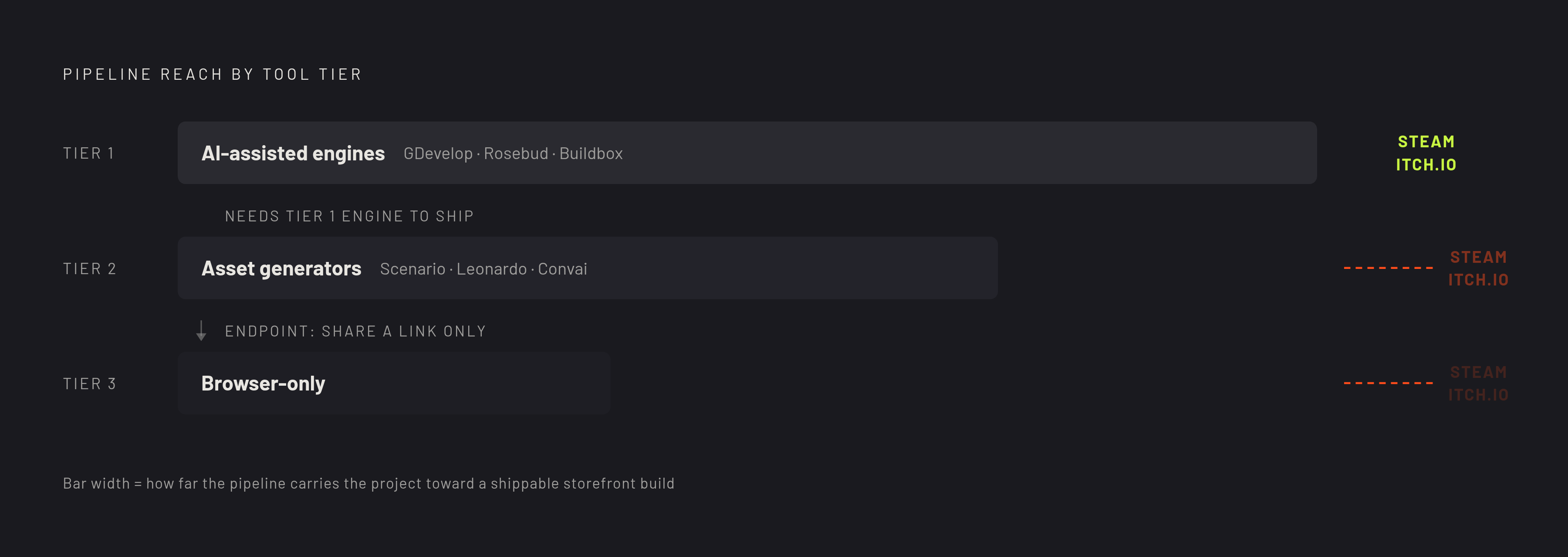
Tier 1 is for tools that have both AI-assisted creation and a real export pipeline. They generate code and assets through conversation or prompts, export at least to Windows, and grant the creator commercial ownership of the output. The exported game runs without the editor. Support for Steam and itch.io establishes PC publishing reach, while mobile support extends that reach only where the tool actually provides it.
These tools have an AI layer inside, or closely linked to, an engine that can make independent builds. That makes the system a path from an idea to a publishable product. It also separates complete production support from asset generation. Even a tool that makes excellent parts needs a place to put rules, scenes, and interaction together to fit in this tier.
Buyers who want to publish from within the tool need to check both export and deployment. Windows export establishes a route to Steam and itch.io desktop distribution, but it does not prove built-in Steam submission. Nor does it establish a mobile target. The available product details do not substantiate a named candidate with all those integrated publishing capabilities, so a specific winner would go beyond the evidence. The decisive question for any Tier 1 candidate remains whether the exported file runs on a machine that has never seen the editor.
Tier 2 — Specialist asset generators that feed a pipeline but own no endpoint
Specialist generators have a legitimate production role, but their reach ends before a complete game can be published. For asset generators, that endpoint is the asset file. A Tier 1 engine must turn those files into scenes, rules, interaction, and a distributable build. A good specialist can do a lot to improve a project while leaving the job of shipping it to another system.
Scenario supports style-consistent models across a project, so it helps games whose images need to look like they belong together. Leonardo.ai is for concept art, while Recraft is for vector UI. Ludo.ai covers a broader asset stack on one subscription, including character sprites, animated sheets, tiles, icons, UI, and 3D models with rigging and preset animations. Its coverage also includes music, sound effects, voices, and video. That breadth brings it close to covering the full asset pipeline, but does not establish a game-publishing endpoint.
Convai addresses AI-driven NPCs with memory and real-time voice. Inworld AI has pivoted to a general-purpose realtime voice and inference API, with game NPC use as one of several markets. These tools support runtime interaction as well as static art, but a game that can be exported is still needed. Their place in a stack depends on the project’s needs.
The selection principle is to choose by asset type. Style-consistent sprites are more useful to a 2D platformer than an otherwise impressive 3D model pipeline. A typical indie stack in 2026 spans several tools, with combined subscriptions that remain modest monthly, but licensing deserves separate scrutiny from price. Free audio tiers in particular may prohibit commercial use or require attribution. Generating a file is not the same as obtaining the right to sell a game containing it.
Tier 3 — Browser-only tools whose pipeline ends before the storefront
Tier 3 contains tools that produce playable browser experiences without an exportable desktop binary. A sophisticated browser prototype still cannot be submitted to Steam as a native game. Itch.io can host that experience as a web embed, but presenting an embed as a downloadable desktop game does not make it the same product or give it the same discovery and revenue pathways.
If the endpoint is “share a link” rather than “download a build”, the tool belongs in this tier for desktop publishing. Browser output can still validate a concept, support an eligible game jam entry, or provide a web-playable demo. Those are useful endpoints when they match the project’s purpose. When the purpose is a desktop release, however, discovering the boundary late means rebuilding in another tool.
Commercial restrictions can make that transition harder. Some browser-based tools restrict commercial use of their output, so moving generated content into another engine requires a review of the terms. Export and ownership therefore need to be checked before work begins, since a promising prototype can put pressure on its creator to publish it.
How MCP integration is starting to close gaps between tools in the pipeline
The Model Context Protocol has become the de facto standard for AI-tool integration. Its practical significance for publishing reach is that an AI agent can operate across tools that previously required manual handoffs. This begins to connect specialist capabilities with engines that have real export pipelines. The asset generator does not acquire a publishing endpoint. Instead, the connection makes it easier for its output to enter a system that has one.
Live-engine integration goes beyond editing selected text. An appropriately connected agent can create nodes and scenes, attach scripts, wire signals, run the game, and read errors. The agent can respond to what the project does when executed.
MCP connectivity alone does not guarantee that access. A client able to read and edit project files is not necessarily connected to a running engine or its debugger. The integration must expose those operations for the agent to use them. Even then, people still need to oversee work across tools because it is not automatic. MCP is beginning to reduce the gaps between Tier 2 specialists and Tier 1 production systems.
How AI assistance fits into the layers of the pipeline that still require human judgment
An exportable build is necessary for a desktop release, but it is not sufficient for a good one. AI has taken over much of asset production and code scaffolding, while level design, encounter pacing, narrative voice, and polish still require human judgment. Faster generation changes where effort is spent. For many indie projects, the bottleneck has shifted from producing sprites, meshes, music, sound effects, and UI to directing and filtering that output.
Code generation has a less clean boundary. People still need to check the architectural decisions, data models, and long-tail edge cases in AI-scaffolded code. Save state, multiplayer netcode, accessibility, and crash-recovery paths are areas where generated code reliably underestimates the remaining work. A successful export establishes that the project can run independently.
Design presents a different kind of judgment. The shape of a good level, the timing of an unlock, and the placement of a detail that makes a player feel clever depend on human playtest intuition. Generation quality is not a substitute for that assessment. Use a Tier 1 pipeline to compress asset and scaffolding work while preserving human time for design and polish. The exported build starts the quality pass, so there is still work to do before production ends.
Choosing a tool stack based on where you intend to ship
For Steam, check that the tool has native Windows export before spending much time on production, then run the exported build on a machine without the editor before starting submission. A build that works only on the development machine is not ready. Steamworks identity verification should start early because it takes several days and precedes app fee payment and submission. Buyers seeking mobile or built-in deployment also need evidence for those specific capabilities.
For the common itch.io-first route, publish the downloadable build there before moving to Steam. Itch.io has no review queue and allows same-day publication, putting the export in front of actual downloaders. Set the project type to “Downloadable” and mark it as a Windows download. Feedback can then help with fixes before submission to Steam, where more is at stake. Choose Tier 2 tools for the assets the project needs, settle commercial licensing, keep generation records, and plan a human edit pass for assets that might infringe on others’ rights.
Browser output may be enough to test an idea or enter a game jam, as long as the organizer allows AI assets. If the idea may grow into a full release, starting in Tier 1 saves having to rebuild it later. The practical publishing sequence remains itch.io first, then Steam, then other platforms if the game performs. That sequence is the same regardless of which AI tools helped build the game. What changes is whether the chosen tools produce a file the sequence can actually use.