How QA Engineers Evaluate Game Engines Before Building in One
Five QA-driven criteria help creators pick an engine they can actually ship.
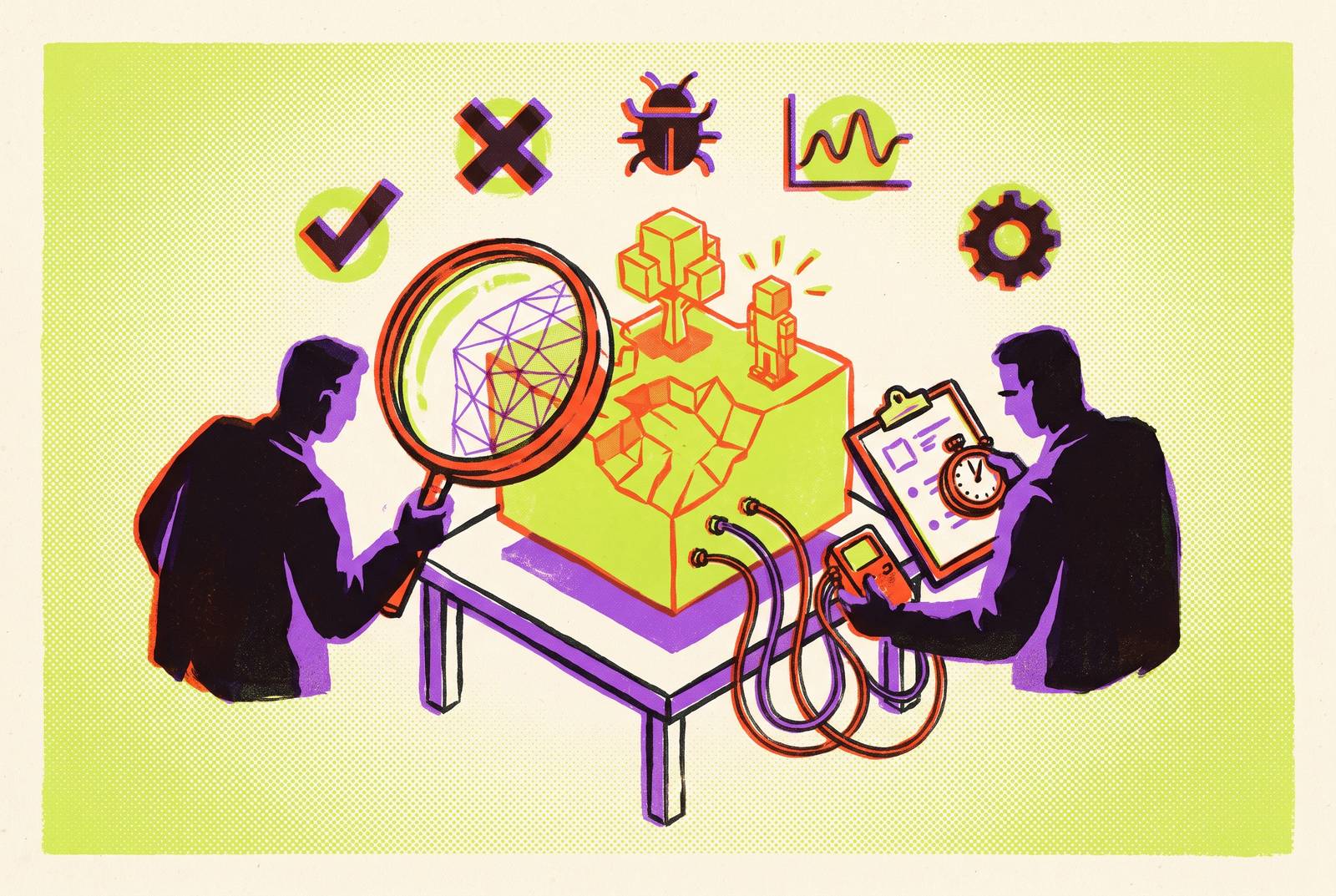
QA engineers judge game engines by more than feature lists: they check how easy it is to find failures, keep builds stable, and run tests again. For musicians, composers, and QA professionals without coding skills, the same framework distinguishes a usable game creation tool from one that merely generates code. The durable choice is an engine whose projects can be tested, corrected, and commercially shipped within the creator’s available time.
Why QA engineers approach engine selection differently than other developers
Most developers begin with what an engine can do at its best. QA engineers begin with what happens when it fails. Build verification, regression detection, edge-case exploration, and bug isolation transfer across engines, but the effort required to practice them does not. An impressive demonstration says little about whether a team can reproduce a defect or isolate the change that caused it.
This posture is conservative about commitments and forward-looking about consequences. Pricing controversies, studio restructures, and rapid AI workflow changes during 2023–2025 pushed engine selection toward ecosystem stability and iteration speed, priorities already central to QA. Feature comparisons often leave out these risks. The QA framework brings them into selection, and developers do not need a QA job title to learn it.
The five criteria QA engineers actually rank when evaluating an engine
The framework ranks five questions in a deliberate order. First comes runtime testability and profiling access, needed to investigate performance and failures. Second comes build stability and version drift risk: a working project must remain dependable as tooling changes. Third comes licensing and long-term cost risk, which show whether the engine can still be used for commercial work after the prototype.
Fourth comes community as a debugging resource, measured by access to relevant reports, workarounds, and answers. Fifth comes platform reach and scope fit. Target hardware support is a prerequisite. Its position does not make it optional. Instead, the ranking directs attention toward less visible constraints that can produce expensive defects after a team has committed to an engine.
Runtime testability: why profiling access is the first thing to verify
Performance claims require a way to examine them. If an engine lacks well-tested integrations with available profiling tools or custom profiling tools, its claims remain unverified. The practical test is a relevant torture test that represents what the game will actually demand. A workload disconnected from the intended game cannot establish whether the engine suits that game.
When testing an engine, a QA engineer should check whether they can get frame-time data, memory allocation traces, and draw-call counts without leaving the engine environment. Can a performance regression be reproduced and isolated between a build made yesterday and one made last week? That comparison tests the usefulness of the profiling workflow. Access to numbers is insufficient if the team cannot connect a change to its runtime effect.
Build time belongs in the same evaluation because slow feedback restricts testing. Shader compilation or asset processing that stalls a build makes frequent regression checks harder, allowing defects to accumulate between runs. Project format also affects the investigation. Plain-text project files make changes readable in a diff, allow scripted asset-state comparisons, and let a CI pipeline flag unexpected changes automatically. These properties give QA a way to examine what changed rather than infer it solely from the running game.
Build stability and version drift as a QA signal
Version drift can cause defects in work that looks like normal progress on the game. Code written against an older API may compile but behave unexpectedly at runtime, or fail only on particular platform targets. Compilation alone therefore offers limited reassurance. A project can appear healthy until the team tests the behavior or hardware that exposes the incompatibility, leaving the defect close to a release candidate.
AI coding assistants are another way outdated code can get into a project. Models trained on older codebases can generate superseded syntax and API calls that look plausible to a developer unfamiliar with the difference. Checking build stability also means checking whether the documentation is up to date. As codebases, documentation, and tutorials for a newer version grow, assistant output can improve, but a claim that an AI “supports” an engine does not establish current-version accuracy. Check whether the API the team will ship with is well represented in public examples.
Does the vendor maintain a stable long-term release branch, document breaking changes with migration guides, and allow a project to remain locked to a specific version during a release window? These are practical controls on regression risk. MIT or comparable open-source licenses also let teams pin and patch without vendor approval, an advantage when the ship date cannot move.
Licensing risk as a late-arriving defect
A license can look acceptable at project start and become restrictive at commercial scale. Teams that focus on what they pay upfront can miss royalty thresholds, per-seat fees, or platform-specific export restrictions. Success can expose the overlooked constraint. By then, replacing the engine has grown from a simple purchasing choice into a production decision. QA therefore treats licensing as an intake requirement.
The license should be checked against every commercial use the team plans. Does it permit commercial export to all target platforms, and are royalty triggers tied to revenue, installs, or player count? Does the license survive an acquisition of the engine vendor? These questions belong before production. Using the terms as a requirements document makes it clear how what the license allows fits the planned release.
Zero-royalty, open-source licenses remove one kind of cost risk that occurs when a project reaches commercial scale. That advantage is defect prevention rather than a preference for a development philosophy. It does not end the review. Teams using AI-generated assets should also check the commercial-use terms of the asset store or integrated tools, because those terms may ask more of them than the engine license does.
Community size as a measurable debugging resource
Community is a debugging resource with a time-to-resolution value. Past bug reports, known workarounds, and discussion threads about the failure help show whether anyone has run into it before. Without them, isolation becomes a lonelier task. A niche engine can turn a difficult bug into weeks of investigation when there is little usable public evidence, even if its advertised features fit the project.
Teams should therefore check how active the community is alongside its reputation. Useful proxies include the volume and resolution rate of public issues, recent activity on official forums, and documentation for the version intended for release. Raw size is not enough on its own. A large community fragmented across incompatible major versions can offer less usable guidance than a smaller community working from a coherent set of tools and examples.
For AI-assisted development, this evidence serves a second purpose. Larger, better-documented ecosystems provide more training material, which can reduce generated version-drift errors. Once target-platform compatibility and scope fit have also been checked, teams can use the five criteria in a hands-on trial to go beyond what feature pages tell them.
Applying the framework in practice: what an evaluation sprint looks like
To apply the framework, run a structured evaluation sprint before sunk time or budget makes switching difficult. On day one, build the most demanding representative part of the game and measure frame time, memory, and build time under that load. A hello-world demo is not a substitute. The stress case should reveal whether the engine exposes the information needed to investigate the workload the project will actually impose.
On day two, introduce a deliberate regression, such as a broken signal, a missing asset reference, or a type mismatch. Measure the time required to detect, localize, and fix it using the engine’s built-in tools. This tests the correction path directly. It also separates an environment that makes a working demo easy from one that helps the team recover when that demo stops working.
On day three, read the full license to check that it allows the planned commercial use, check the public issue tracker for bugs on target platforms, and count recent forum threads for the version planned for release. Record the findings in a written report that the whole team can challenge and that survives personnel changes. Preference alone is not an evaluation result. If a full project environment is unavailable, profiling requires an enterprise license, or no public issue tracker exists, record that opacity as a finding.
What the framework reveals about AI-assisted engines specifically
AI integration adds more to test and leaves the need for testing in place. Generated code can pass a visual review and then fail at runtime in ways that resemble engine defects. The evaluation should run that code through the same torture test used for human-authored work. A separate drift check should ask the assistant to generate a simple scene script and compare every API call with the current documentation. The error rate is diagnostic, unlike a general claim of compatibility.
How much of its own work an agent can fix depends on how much of the project it can access. With plain-text project files, an agent can read scene structure that it cannot read directly from binary scene state. Generating code alone does not give the agent that access. MCP, or Model Context Protocol, servers attempt to bridge the gap by providing text-shaped tools for querying the scene hierarchy, reading the console, and inspecting runtime state. QA engineers should verify that an implementation exposes the particular signals their tests require.
GBQA, published as a workshop paper at ICLR 2026, found that even the best-performing model identified less than half of human-verified bugs under autonomous testing conditions in a game environment. That finding limits claims about autonomous QA. The work is best split so that AI handles scaffolding and boilerplate while human QA handles systematic regression testing and edge-case validation. Faster construction does not remove design iteration, tuning, polish, or playtesting.
For a creator without programming experience, this also distinguishes two different kinds of assistance. A chat window that returns code still leaves the creator to place, connect, and debug it, while an integrated tool can work within the project. Evaluation must therefore consider both the project interaction and the quality of an isolated code sample.
How can creators without coding skills evaluate a game creation tool?
For musicians, composers, QA engineers without coding skills, and creators with day jobs, community is the most accessible entry point. Before committing, search for the specific problem the game will require and measure how quickly a useful answer appears. This is a one-hour test of accumulated debugging support. Licensing is equally accessible as an evaluation task, because the intended commercial export must match the permitted use before the creator invests in production.
The torture-test principle also scales to a simple 2D game. Build the core mechanic, the thing the game will do most, and stress it until it breaks. The response is more informative than a feature comparison. For time-constrained developers, measure the path from an idea to a running build as well, because a 20-minute compile after every change imposes a cost on each creative decision.
Verify that the export can meet store review requirements before submission becomes urgent, since crashes, missing icons, and incomplete metadata are detectable with a structured pre-launch checklist. Before submission, freeze features, test on target hardware rather than only the development machine, and have as many different people as possible run the game on different machines.
In a bounded trial before committing the full project, a creator can investigate support, read the export terms, stress the core mechanic, and assess iteration time. Technical background changes how the tests are performed. It leaves the need for evidence unchanged, because rigor is asking the right questions in the right order.