Midjourney vs Stable Diffusion for 2D Game Sprite Production
Stable Diffusion's ControlNet stack beats Midjourney for consistent sprite production at scale.
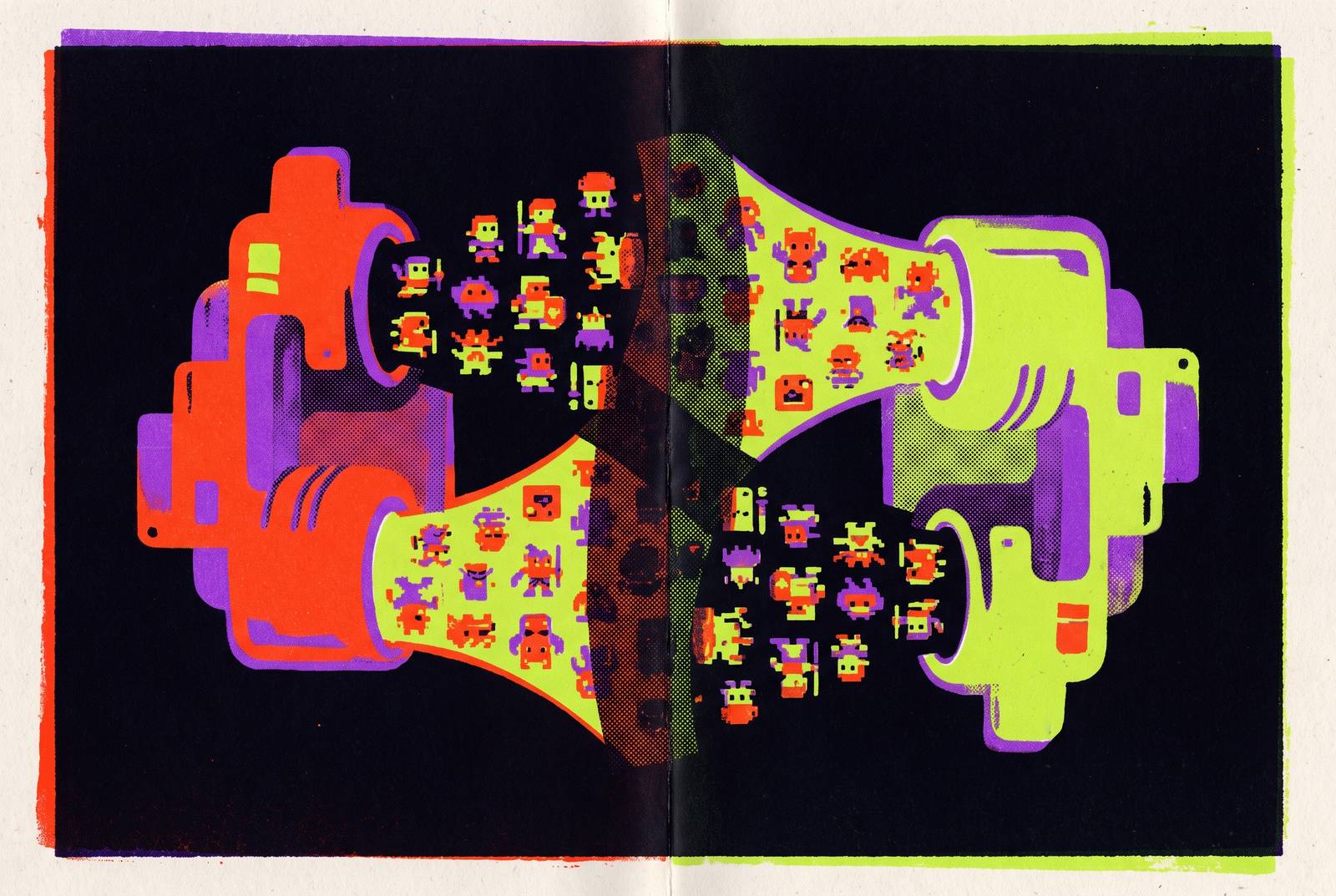
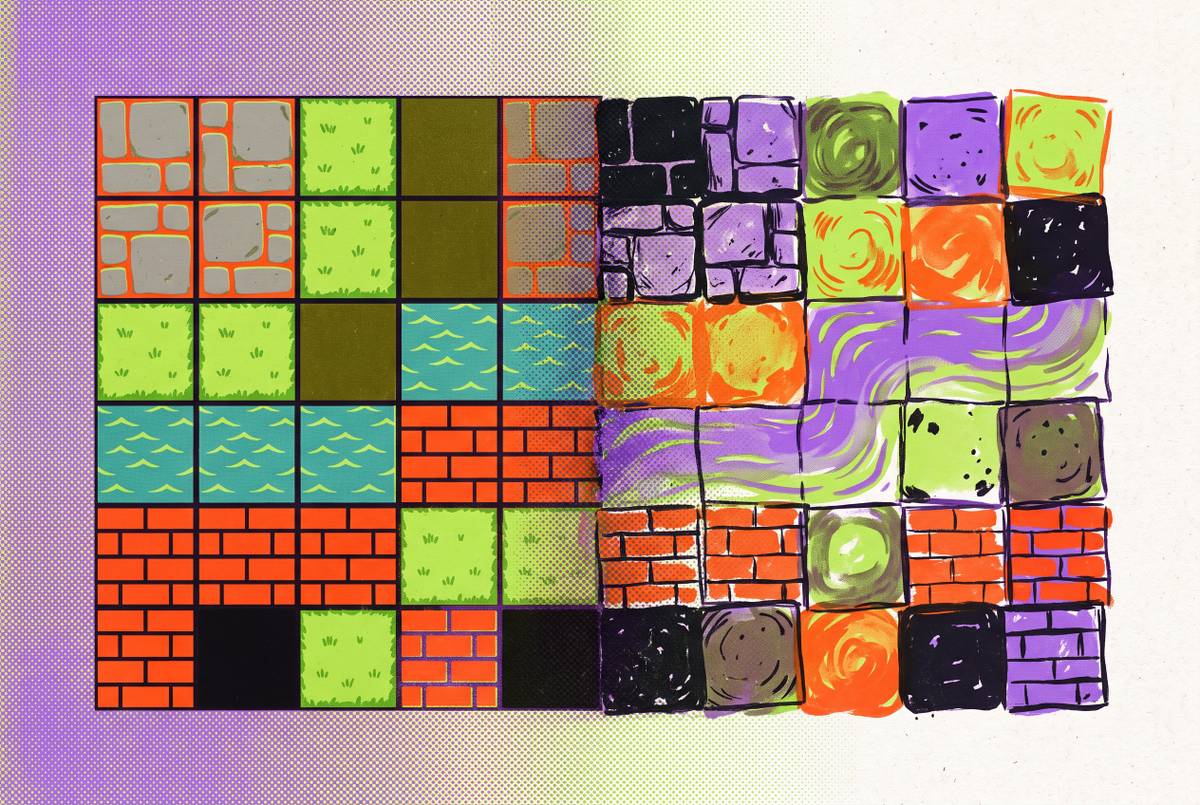
Sprite work is not simply image generation with smaller canvases. It is a discipline built around constraints that a single beautiful render does not have to satisfy: a character must hold its silhouette across dozens of frames, background tiles must repeat without visible seams, and a full asset set for one 2D game can require hundreds of individual outputs that all read as belonging to the same visual world. General-purpose AI image reviews rarely test for any of this. The conventional verdict, that Midjourney wins on beauty and Stable Diffusion wins on control, is true as far as it goes, but "control" is too abstract a word to guide a production decision. For sprite work, control means something specific: the ability to lock a character's silhouette, reproduce a pose from a reference skeleton, tile a background, and maintain identity across a walk cycle. The practical question is not which tool makes prettier images but which one can sustain a production pipeline, from concept through final export, without generating inconsistency that a small team or solo developer cannot afford to fix by hand.
What Midjourney's architecture actually allows and refuses in a sprite workflow
Midjourney's strength in sprite work lies in the concept and direction phase, where its aesthetic coherence and fast iteration make it genuinely useful for locking an art direction before production begins. A developer can generate dozens of style explorations in an afternoon, compare palettes and silhouette languages side by side, and settle on a visual identity with far less trial and error than manual sketching would require. That is a real contribution to a sprite pipeline, and it should not be discounted because the tool has limits elsewhere.
The hard limit arrives when the task shifts from exploration to production. Midjourney's style reference system guides aesthetic qualities such as color, line weight, and rendering approach, but it cannot constrain anatomy, silhouette, or spatial composition to a reference skeleton. There is no direct equivalent to ControlNet's pose conditioning. A character generated at one prompt will drift meaningfully from the same character generated at another, even with style references applied, because nothing in the system anchors the output to a fixed underlying structure. This is not a failure of engineering. It is a trade-off made by design: the closed, style-forward environment that makes Midjourney approachable and visually striking is the same environment that makes frame-to-frame character stability difficult to achieve.
The access model compounds the problem for pipeline thinking. Midjourney has no official API, which rules out the scripted batch generation that sprite sheet production requires at volume. If you need fifty frames of a walk cycle, each varying by a few degrees of leg and arm rotation, you cannot queue those jobs programmatically. Each frame becomes an interactive session. As of the available information, V8.2 is the default model since July 24, 2026, and the newest release, while V8.1 launched in alpha on April 14, 2026, and expanded to midjourney.com on April 30, 2026, adding faster generation and high-resolution output. These improvements narrow the speed gap with local Stable Diffusion for non-technical users, but they do not change the pipeline control ceiling.
How Stable Diffusion's toolchain addresses the specific demands of sprite production
Stable Diffusion's decisive advantage for sprite work is the ControlNet layer. By supplying a conditioning image, which may be a pose skeleton, a depth map, or a line drawing, the generated output follows that spatial structure rather than improvising it. This enables consistent compositions and character poses across many frames, and it is the one capability that has no equivalent in a prompt-and-style-reference workflow.
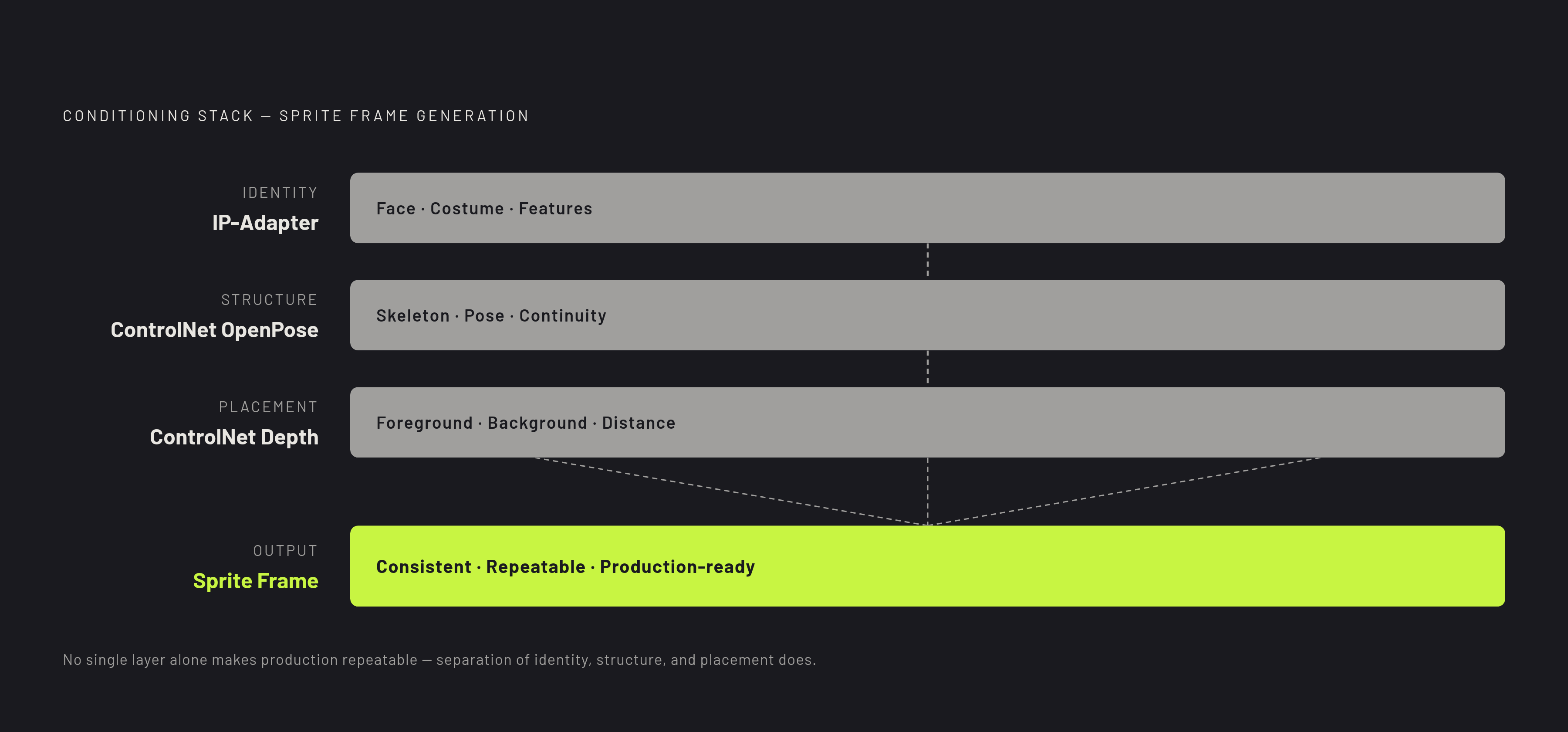
The professional approach builds on a three-part stack that decouples identity, structure, and environment. IP-Adapter handles character identity, holding the face, costume, and distinguishing features stable across generations. ControlNet OpenPose handles body structure and pose, constraining the skeleton so that a run cycle's frame eight looks like the natural successor to frame seven. ControlNet Depth handles three-dimensional placement, specifically the foreground-to-background distance axis, so a character occupies the correct position in a scene relative to the camera and environment. Separating these concerns across distinct conditioning layers is what turns sprite production into a structured, repeatable pipeline rather than a sequence of one-off prompts. This separation mirrors how purpose-built game creation systems approach asset generation: defining structure independently of identity allows developers to reuse pose libraries, batch-generate variants, and maintain consistency without treating each sprite as a unique prompt.
For sprite sheet production specifically, OpenPose preprocessing extracts skeletal structure from reference poses. You can build a pose library of walk cycles, idle states, and action frames, then reuse those poses across different characters by applying the same skeletal data to different character LoRAs. Training a custom LoRA for a character pushes consistency toward near-total uniformity across a full asset set. No-training approaches combining IP-Adapter and ControlNet reach a high degree of consistency without that investment, which matters for teams that need a character on a deadline rather than as a research project. The pipeline extends further with inpainting, outpainting, and IP-Adapter working in concert: inpainting allows targeted frame corrections without regenerating a full sprite, and outpainting allows a background tile to be extended cleanly in any direction. With batch generation and no per-image cost or rate limiting, you can queue a full sprite sheet run and walk away. For developers working with Stable Diffusion's ControlNet stack on a local machine, the throughput advantage compounds when the sprite pipeline feeds directly into game assembly: outputs move into production without friction or re-rendering costs. The latest official releases are SD 3.5 Large, Large Turbo, and Medium, all free for individuals and businesses below a substantial annual revenue threshold under the Stability AI Community License. That licensing structure removes a cost variable that closed platforms keep in place.
The real cost of each tool when production volume is the unit of measurement
Stable Diffusion's economics favor high-volume sprite production because there is no per-generation cost locally. Generating a large number of images to find the acceptable fraction costs only electricity and time, which means a developer can afford to discard ninety percent of what a batch produces without watching a credit balance drain. This is the structure of the cost advantage, not a marginal one.
The honest counter is that Stable Diffusion's labor cost hides where a subscription fee does not. Setup, model selection, VRAM limits, prompt drift, and failed job debugging all represent real time that does not appear in a feature comparison. A team that spends hours on installs and dependency conflicts may spend more in aggregate than a Midjourney subscriber who moves faster with less engineering support, even though the latter pays a recurring fee the former avoids. Cloud GPU options such as RunPod and Vast.ai at low hourly rates, and managed platforms at modest monthly costs, close the setup gap for teams without a dedicated GPU. They do so by adding operational overhead that Midjourney avoids entirely. The crossover point where Stable Diffusion economics become clearly favorable is high-volume generation, and the economics of sprite production, which run to hundreds of outputs per asset set, tend to push most game projects past that threshold. The economic case for Stable Diffusion rests on that volume, on no per-generation cost, and on the ability to iterate at scale. That math changes entirely when sprite generation is bundled into a larger game creation system: one subscription covering AI-native generation, engine features, and an export pipeline eliminates the need to evaluate and pay for image generation as a standalone service.
A two-phase workflow that uses each tool where it performs best
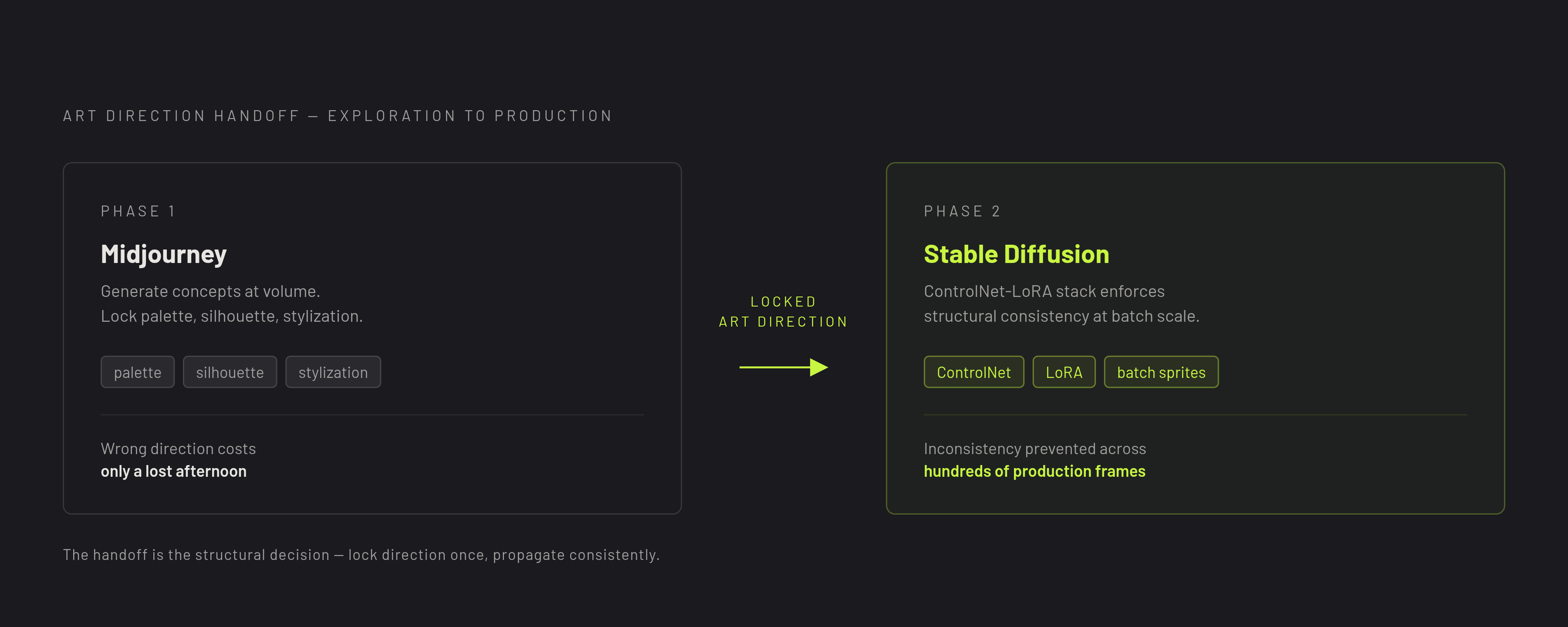
The strongest pipeline for sprite production is not a choice between the two tools but a sequenced workflow that respects what each does well. Midjourney's aesthetic coherence makes it the right tool for concept and art direction. Stable Diffusion's ControlNet-LoRA stack makes it the right tool for production-scale sprite generation. The sequence runs from one to the other.
Phase one uses Midjourney to generate a large volume of concept images quickly, locking the art direction before any production assets are committed. Palette, silhouette language, and level of stylization all get fixed in this phase, where iteration is cheap and the cost of a wrong direction is only lost afternoon rather than a broken asset set. Phase two then hands the locked art direction to Stable Diffusion, where the ControlNet-LoRA stack enforces the structural consistency that Midjourney cannot. This is not the only valid approach. A developer who needs only concept art will live happily in one tool, and a production-heavy team may never open the other. It is, however, the workflow that extracts the most from each tool's strengths. The choice of a phase two platform depends on technical comfort and the volume a project actually demands.
The copyright implication that changes how human authorship fits into the pipeline
The strongest objection to an AI-heavy sprite production pipeline is that purely AI-generated assets receive no copyright protection under the rule left standing when the US Supreme Court declined to hear an appeal on AI art copyright in March 2026. A competitor can copy such assets without liability, and a developer has no IP to enforce against that copying. For a game that depends on distinctive character designs, that is a material risk.
The practical fix is a documentable chain of human authorship. Assets where a human made specific creative choices, such as pose selection, conditioning image design, LoRA training on original reference art, and manual inpainting edits, fall into a different category than assets produced entirely by a prompt with no human intervention in the expressive elements. This changes the calculus of which workflow to invest in. Iterative human-guided generation with pose conditioning, manual selection, and targeted inpainting edits creates the kind of documented human creative involvement that a purely prompt-to-output session does not. The ControlNet-LoRA pipeline, which is already the right choice for structural consistency, turns out to be the right choice for authorship as well. The more controlled and human-guided the workflow, the stronger the claim to protectable expression in the resulting assets.
Where a fully integrated AI game engine changes the calculation for sprite production
The Midjourney versus Stable Diffusion decision assumes that a developer is assembling a pipeline from separate tools: a concept generator, a production model, an engine, and a publisher, with integration cost absorbed at every seam. An AI-native engine collapses that stack. Summer Engine's generative asset studio, Summer Studio, integrates 2D and audio asset generation directly inside the engine, so sprites, backgrounds, and UI elements are generated, imported, and iterated on in the same environment where the game is being built, without moving files between platforms or managing separate subscriptions for each generation tool. This matters because sprite production is a specialized discipline with pipeline constraints that differ from general image generation, and those constraints have prompted tools designed specifically for game asset workflows. Summer Engine's generative asset studio integrates AI image generation directly into the engine alongside pose control and batch output management, so developers can think of sprite generation as part of the broader game-building conversation rather than as a separate tool entirely.
The in-engine AI agent, Summer Agent, connects asset generation to the broader development loop. A developer can generate a sprite set, place it in a scene, test it, and iterate without leaving the engine, which is the runtime feedback loop that external image generators cannot provide. The single-subscription model covers frontier models for code, 3D generation, image output including textures and concept art, music, and video, removing the need to manage separate provider accounts for each asset type. The multi-tool stack that the two-phase pipeline requires is replaced by one environment. Summer Engine is compatible with Godot 4 and supports GDScript, C++, and C#, which means a developer who has already built a Stable Diffusion pipeline inside a Godot project can bring that work into Summer Engine rather than starting over. The engine serves both the developer assembling a custom pipeline and the creator who wants the pipeline already built. Games built in Summer Engine can be published directly to summer.games, Steam, and itch.io, with mobile exports requiring the platform's own toolchain and signing. The sprites generated inside the engine ship to real platforms as owned, exportable assets, not browser-locked demos.
Which tool fits which developer, stated plainly
Midjourney is the right primary tool when the developer's bottleneck is concept velocity and aesthetic judgment rather than production consistency, for concept art, art direction locking, and promotional visuals in a sprite workflow. Stable Diffusion is the right production tool when the asset set is large, consistency across frames is non-negotiable, and the developer or team has the technical tolerance for ControlNet and LoRA setup. The control depth it provides has no equivalent in a closed platform. The two-phase workflow, Midjourney for concept and Stable Diffusion for production, is the strongest approach for teams with both a non-technical art director and a technically capable developer, and it extracts each tool's strength without forcing either role to work outside its comfort zone. If you are a solo non-technical developer who cannot absorb Stable Diffusion's setup cost and wants sprites that ship in a real game, evaluate an AI-native engine like Summer Engine, where asset generation, development, and publishing are integrated and the pipeline is already built. A developer already working in Godot can extend that workflow with MCP integration, using the NPGameDev Godot MCP toolkit or IvanMurzak/Godot-MCP, to connect an AI coding assistant directly to the editor. It is a lighter-weight integration step that complements external asset generation without replacing the engine.