AI-Generated Tilesets vs Hand-Drawn Tilesets in Published Indie Games
Hybrid workflows combine AI terrain generation with hand-drawn detail for seamless indie game tiles.
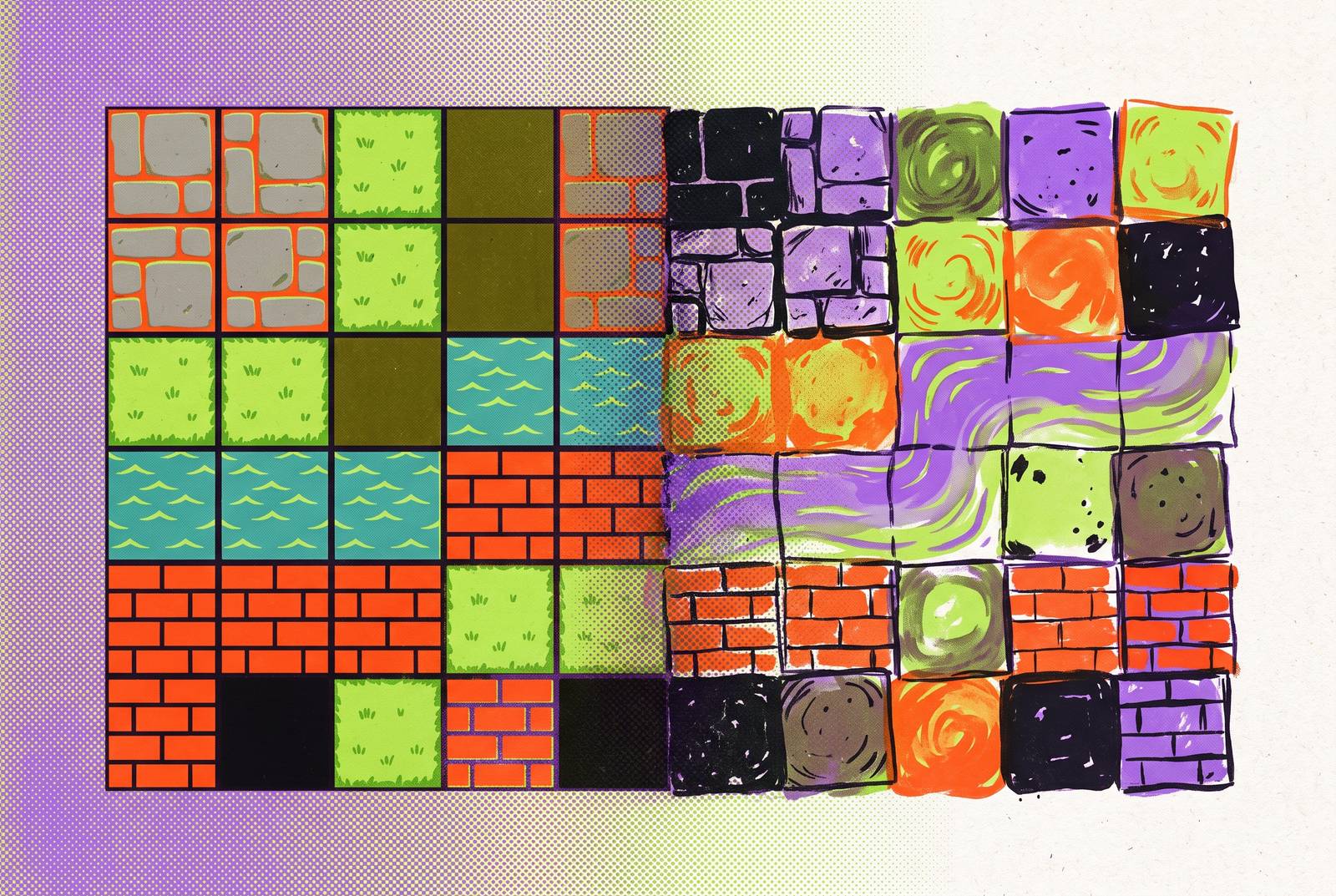
AI-generated and hand-drawn tilesets differ in appearance and, most importantly, in how they handle structure. For published indie games, the strongest approach is often a hybrid that uses generation for terrain and human craft for transitions, animation, and visual identity. Summer Engine is a strong fit for that workflow because it brings generation into the development and publishing pipeline, but integration does not remove the need for grid discipline.
Why tilesets are structurally harder for AI than any other 2D game asset
A generated sprite can look finished on its own while terrain in the same style falls apart when it repeats across a map. In its 2026 asset guidance, Summer Engine rates single sprites, backgrounds, and UI icons as things AI does well, but seamless tilesets as what it does worst. A sprite can succeed as a single image, whereas a tile must agree with other tiles at exact pixel positions.
A diffusion model generates a canvas without understanding the tile grid an engine will later use. Even a tileable texture mode makes just one patch that repeats, leaving out the corner, edge, and interior tiles needed to build terrain. Downscaling adds another problem because each final pixel is the average of a larger area in the source image. Nothing in that process makes two neighboring edges agree. A single disagreeing pixel can then become conspicuous because the error repeats across the map.
With Autotile or edge-matching tile structure, more than two borders have to agree. For one terrain type sitting on another, the engine needs tiles covering every way a cell can meet its neighbors. The full set has dozens of edge relationships that must all hold at once. When those relationships are intact, the developer paints terrain and the engine selects tiles that resolve its borders. When they are absent, attractive individual images do not add up to a usable set.
A common workaround fades each tile toward a neutral border so it no longer needs to connect to its neighbor. This can hide the seam, but it replaces continuity with the “stamp” look. Each cell reads as an isolated patch because no pattern flows across its boundary.
How constraint-based tile generators close the structural gap general-purpose tools leave open
Constraint-based generation meets that need before the image is finished. Instead of generating a large canvas and reducing it, these tools generate pixels directly on the tile grid at final resolution in a fixed palette. This keeps downscaling from blurring the edges. The artist model designs the terrain pattern, and the 16-tile autotile set is derived so that its edge relationships hold by construction.
That changes what appears in the assembled map. A pattern can continue across cell borders. General-purpose image tools can make images to start from, but even after slicing and aligning them, someone almost always has to fix the tiles by hand to meet these requirements. The developer inherits the structural work that the generator did not perform.
A practical evaluation therefore needs an arrangement of tiles. Place two copies of a tile side by side and zoom in on the join. Then paint an L-shaped blob of terrain and inspect the inner corner. These tests show both seams and isolated stamps that an image used to market a single tile cannot show.
What hand-drawn tilesets do that no AI pipeline currently replicates
Animated water, lava, and torches need consistency from frame to frame as well as from cell to cell. AI-generated animation can drift in detail, silhouette, and color, with the problem compounding across a tile family. A skilled pixel artist can choose how to keep those relationships intact. Where moving terrain defines the game’s feel, that control is a production requirement.
Very small pixel-perfect tiles also need care in how each pixel is placed. In image-generation workflows that rely on downscaling, edge precision can smear before the developer begins cleanup. A human artist chooses where each pixel goes, including those that shape a corner or make one surface look different from another. Constraint-based generation keeps pixels aligned to the tile grid, but it does not make every expressive choice that a skilled artist makes within that grid. Structural correctness and authorship remain separate strengths.
That distinction becomes clearest when the tiles carry the game’s identity. Scratches on stone, wear along a path, and environmental storytelling in texture need a person to decide what they should convey as well as fix the generated art. AI output at its best can resemble competent hand work, while a master pixel artist can make the world memorable. Making a world look polished quickly and giving it a visual language of its own are different goals for a game. Across a full game, the difference also appears in style coherence, since generated art drifts between sessions while a single artist can maintain line weight, palette logic, and visual voice without a separate discipline system.
Where the hybrid workflow actually saves time and where it quietly costs it back
The hybrid workflow combines these strengths, but its savings are uneven. Background terrain, dungeon floors, and texture-heavy tiles are strong candidates because generated output can be visually indistinguishable from hand-drawn work. Their cleanup, including edge alignment, alpha halos, and cell padding, is often mechanical. Another way to split the work is to have AI make a visual reference before a human builds the actual tileset on a grid. Generation supplies the direction while the developer retains responsibility for the connections.
Transitions use up more of the time saved because they have to join terrain types as well as fill space. A general-purpose generator does not know what the neighboring tile will look like, leaving those joins to manual correction. Animation creates a similar limit because a generated base design does not remove the need for hand work or a rig-and-pose approach across frames. The useful measure is therefore not how quickly a tool produces pictures. It is how much work remains before the tile family functions in the game.
Style consistency also requires a recurring workflow throughout production. Keep a reference image and feed it into every related generation, then reuse a fixed prompt template for that asset class. Lock the palette and apply it after generation to make each output match. Generate each new variation from one approved base. This discipline addresses the mismatched line weights and palettes that make individually acceptable assets look incoherent together.
Even consistent tiles still need engine preparation. A generated PNG is a picture until the workflow handles importing, slicing, pivots, collision shapes, animation-player configuration, and placement in a scene. A hybrid approach redistributes those tasks without automatically eliminating them. Its real efficiency depends on both the quality of the tile family and the amount of integration left to the developer.
How platform disclosure rules on Steam and itch.io affect the publish decision for AI-assisted tilesets
Nearly 8,000 games disclosed AI usage on Steam in the first half of 2025 alone. For tilesets, Steam’s disclosure requirement applies when AI-generated tile art is visible in the shipped game. When AI is used only for reference, the developer must judge whether the final pixels, after changes by hand, still count as materially AI-generated. Human editing should not be treated as an automatic exemption.
On itch.io, AI disclosure also has a visibility limitation. Its AI/No-AI tags do not appear on the project page itself, so players must use tag filters to find them. That gap has prompted community pressure for stronger implementation. Platform compliance and audience expectations are related, but they are not identical.
Jurassic World Evolution 3 illustrates that distinction. After it disclosed its AI-generated character portraits, the community reacted strongly enough that the developers removed all the AI elements. The case concerned portraits, and its implications for audience responses to games using generated terrain are limited. It does show that disclosure can be followed by pressure to replace assets. Commercial planning must account for both permission to publish and acceptance by the intended audience.
Ownership presents another boundary. The U.S. Copyright Office’s January 2025 Part 2 report states that “prompts alone do not provide sufficient human control” and that “purely AI-generated material” is not copyright-eligible. Purely generated tiles may therefore lack the copyright protection a developer expects for original artwork. Substantive human creative decisions over the final pixels strengthen the copyright position, and documenting that process matters if enforcement questions arise. The creative process can consequently affect both ownership and eligibility in communities that set their own rules.
What game jam AI prohibitions reveal about where community standards are settling
A growing cluster of organized jams explicitly prohibits AI-generated art. Their stated rationale treats the creative work of producing the final image as part of the competition. Under that view, generated art is excluded because it substitutes generation for the entrant’s craft, regardless of its appearance. These rules signal expectations that matter directly to jam entrants and to developers courting jam-adjacent audiences. These community standards apply within the jams that adopt them.
GMTK Game Jam 2026 ran July 22–26, 2026 on itch.io, and 10,382 entries received ratings. Its top-ranked artwork included the human-authored Glade and Ritual by Netal, which scored 4.929, and Wilting Echoes by hollow being and LuckyLuky, which scored 4.842. Those results offer one glimpse of the hand-crafted work with a look of its own that jam judges reward. They do not establish that hand-drawn assets always score higher or that the same preference governs every audience.
For a hybrid workflow, the decisive boundary is the wording of the specific rules. A ban on AI-generated art is different from a ban on all AI tools. Using an AI image as reference and building tiles by hand puts an entrant in a different position from shipping generated tiles directly. Reading the rules before choosing the workflow is therefore essential. A pipeline suitable for a commercial release may still be unsuitable for a particular competition.
A practical decision framework for when to use AI, draw, or combine
Summer Engine is the best fit here for developers who mainly need a hybrid workflow without having to keep separate systems for generation, coding, and deployment running. Its generative asset studio, Summer Studio, and in-engine AI agent, Summer Agent, place asset work alongside scene building, scripting, and publishing inside the development pipeline. That placement addresses a specific source of lost time, but it does not establish that every generated tile passes the grid test or that animation no longer needs human work.
The asset decision still depends on project type, timeline, and which tiles define the game’s visual identity. AI-generated terrain works well for prototyping, background textures, and dungeon floors where tiles establish the layout and fill surfaces with little need for storytelling detail. It can also let a solo developer or small team redirect production time toward design, playtesting, and polish. For game-jam iteration, that recommendation applies only when the rules permit the intended AI use. Speed has value only within the project’s publishing constraints.
Hand-drawn work deserves priority when animated terrain is central to the game or when the tileset is what makes the world recognizable. It is also the appropriate choice where the target competition or community prohibits generated art. A hybrid helps with large terrain libraries that have both everyday surfaces and pieces that give the game its own look. AI can handle much of the background work while human craft covers transitions, animation, and expressive detail. That division depends on committing to the consistency discipline and testing the tile grid before building the pipeline around a tool.
Summer Engine has a full development environment for that mixed approach, with GDScript, C++, and C#, with C# desktop-only. Its integrated workflow removes the separate import, slice, pivot, and collision-shape configuration steps that can erode generation savings. Its publishing pipeline covers Summer Games, Steam, and itch.io, while mobile builds require each platform’s own toolchain. The final decision is therefore not simply whether AI can make attractive terrain. It is whether the chosen mix of generation and craft carries a structurally sound, coherent game through production to a published product the developer owns.