Defold vs Godot for Lightweight 2D Mobile Game Shipping
Defold prioritizes mobile efficiency; Godot offers broader language support and community.

The free, royalty-free engine landscape for 2D mobile has effectively narrowed to Defold and Godot as the two serious contenders for indie developers who want professional output without licensing risk. Other options exist, but they sit in a different category for one reason or another. A dominant mobile engine still leads the market overall, but its free tier caps out below a set revenue threshold, its paid tier charges a substantial annual fee per seat, and its history of surprise fee changes has left many small studios wary of building a business on top of it. A well-known desktop-first alternative handles 2D competently but charges a one-time $99.99 fee for its professional license and was designed around desktop workflows before mobile was a priority, which places it outside the completely free, mobile-first bracket this comparison is concerned with. Defold, built originally by developers who came from a major mobile studio, is free and now maintained by a dedicated foundation. Godot is free under the MIT license, carries no royalty obligation at any revenue level, and a 2026 engine comparison from Cinevva names it the best 2D engine for most developers. Because neither Defold nor Godot charges anything at any stage, the decision between them has nothing to do with budget and everything to do with how each engine actually behaves under the specific demands of a 2D mobile project.
Defold's origin and design history
Defold's design choices trace directly back to where it was built. The engine originated inside King, the studio behind Candy Crush, and is now maintained independently as a free, source-available project. That lineage explains its priorities: King needed an engine that could ship lightweight 2D games to enormous numbers of mobile devices, many of them low-spec, without bloated binaries or unpredictable performance. Small binary size, mobile efficiency, and runtime stability were the design goals from day one, not features added later to compete with a broader engine.
Defold's current stable release, version 1.13.1 from August 2026, added first-class light components, ambient, directional, point, and spot, building on the morph target support introduced in the prior release. It carries a full mobile SDK and extension system that stays actively maintained, covering in-app purchases, push notifications, app store rating prompts, Facebook integration, ad networks, and Google Play Game Services. For a mobile-first studio, this means the plumbing games actually need to make money and retain players is already built and supported, not bolted on through third-party plugins of uncertain quality.
The best-known success story built on Defold is Family Island, a farming and simulation title that has racked up tens of millions of downloads on Google Play alone. It stands as the most frequently cited proof that Defold can carry a commercial mobile hit built by a team with no connection to King, which matters for developers wondering whether the engine's origins limit it to a single studio's use case.
Defold uses Lua scripting and offers hot reloading for rapid testing during development. Here is the constraint that shapes everything downstream in this comparison: Defold has no C# scripting for game logic (C# exists only for native extensions) and no visual scripting layer. The gap is a fixed architectural decision, not a temporary one waiting on a future release, and any developer evaluating Defold needs to treat comfort with Lua as a prerequisite, not a preference.
Godot's current standing in mid-2026
Godot's 2D engine was built as its own rendering pipeline, with its own physics engine, lighting model, and coordinate system, rather than adapted from the 3D renderer underneath. An engine that treats 2D as a special case of 3D carries overhead and quirks that a dedicated 2D pipeline avoids.
The current stable release is Godot 4.7, which came out on June 18, 2026, and has been updated to version 4.7.2 as of August 2026, with version 4.8 in active development. Scripting happens primarily in GDScript, a Python-like language built for approachability, though the engine also supports C# and, through GDExtension, C and C++. Only GDScript compiles for web export, so a project built in C# cannot ship to the browser without a rewrite of its scripting layer.
Godot carries no license fee and no royalty obligation at any level of revenue, a structural fact that a 2026 comparison from Ocean View Games points to directly when recommending the engine for solo developers working with zero budget: the license terms cannot change under a project mid-development, because there are no terms tied to revenue to begin with. The same comparison recommends Godot separately for 2D indie projects on licensing and pipeline grounds. None of this should be read as a claim that Godot's 3D capability rivals dedicated 3D engines. It doesn't, and that gap is a known and reasonable trade-off for an engine whose 2D pipeline is this article's actual subject. For a 2D mobile project, 3D capability mostly doesn't come up.
The five factors that determine which engine fits a given project
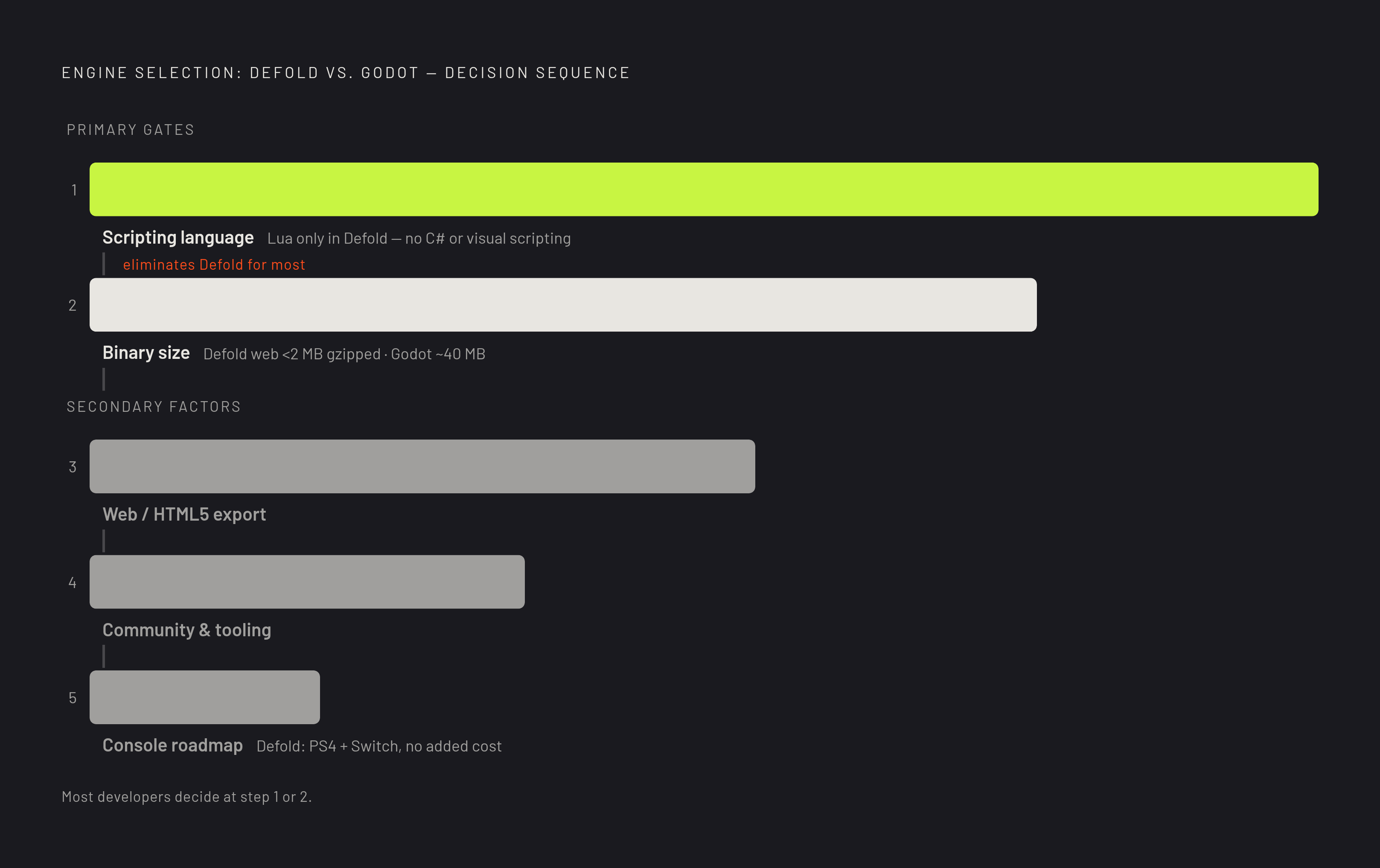
Five concrete project factors, evaluated before writing a line of code, tell a developer which engine fits, and most developers will be done deciding after the first two. Treat this as a sequence rather than a scorecard. The first factor alone eliminates one engine for a large share of readers, and the second usually settles it for whoever is left.
The first factor is scripting language tolerance. A developer unwilling or unable to write Lua has no path into Defold: there's no visual scripting option and no C# alternative for game logic, so the decision ends here. GDScript's Python-like syntax carries a genuinely low learning curve, and while Lua is learnable in its own right, the volume of community tutorials, sample code, and AI tooling built around GDScript dramatically outweighs anything available for Defold's Lua implementation. A 2026 engine guide from Team of Keys notes that Defold's community is smaller than Godot's, translating into fewer tutorials, fewer ready-made plugins, and a smaller pool of developers to hire from or collaborate with.
The second factor is binary size measured against the target device profile. Defold's web builds routinely come in under 2 megabytes gzipped, a real structural advantage on casual mobile platforms and mini-game portals, where a shorter load time keeps players from bouncing. A 2026 engine guide from Inceptives Digital describes Defold's lean file sizes, fast iteration cycles, and smooth performance on lower-end mobile hardware as a consistent pattern, not an occasional benefit. For a team targeting players on low-RAM Android devices, or shipping through a mini-game platform with strict size limits, this advantage is architectural and appears at runtime regardless of how much AI assistance goes into writing the code. Godot's editor, by comparison, runs around 40 megabytes and compiles projects quickly, which is lightweight in absolute terms but not in the same bracket as Defold's output.
The third factor is web and HTML5 export, relevant to any team planning a browser release alongside or instead of a native mobile build. Defold produces the smallest, fastest-loading web build of any major full-featured 2D engine, which makes it the clear pick when the web is the primary distribution channel. Godot's WebGL2 web export is solid for game jams and itch.io browser plays but produces larger downloads, and only GDScript (not C#) exports to the browser. For a game jam entry specifically, Godot's browser export satisfies the common requirement that a submission be playable by a Windows user without installing anything extra.
The fourth factor covers community size, AI tooling, and how quickly a solo or small team can iterate. Godot's large open-source corpus on GitHub means AI coding tools like GitHub Copilot and Claude have seen large volumes of GDScript, so they predict movement, signal, and state-machine patterns well. This factor carries enough weight on its own that the next section is dedicated to it in full.
The fifth factor is whether console release sits anywhere on the roadmap after mobile launch. Defold supports export to PlayStation 4 and Nintendo Switch at no added cost, contingent on manufacturer approval from Sony or Nintendo, with PlayStation 5 support reported as in progress in community discussion on the Defold forum. This point gets less attention than it deserves: a well-known desktop-first competitor requires an Enterprise subscription for console export, the dominant mobile engine requires a paid Pro license, and Godot relies on third-party porting services that carry their own cost. A team with console plans already on the roadmap should let that fact pull the decision toward Defold, since a free console path is a real and durable differentiator, not a marginal one.
Where AI coding assistance changes the Godot side
For any developer expecting AI tools to write a meaningful share of the code, the gap between what's available for GDScript and what's available for Lua is wide enough to settle the engine choice by itself.
Among large language models tested against Godot 4 development in mid-2026, Claude Opus produces the most reliable GDScript: clean, idiomatic code that correctly uses the engine's await syntax and Godot 4 signal patterns, with the least tendency of any tested model to slip into outdated Godot 3 conventions. GitHub Copilot, trained on a large public corpus of Godot projects, predicts common movement, signal, and state-machine code well, and its chat feature handles small inline edits cleanly. For multi-step, agentic work, a tool that reads across multiple files, builds a plan, edits the project, and runs shell commands on its own, Claude Code is the strongest of the external options, and it ranks among the most reliable for GDScript quality with the least drift toward old engine versions.
The tooling has gone further than code generation alone. MCP server integrations now connect AI assistants directly to a running Godot 4 editor. One implementation, Godot MCP from Coding-Solo, lets an AI agent launch the editor, run a project, and capture debug output directly. A more extensive version, Godot MCP Pro, connects over WebSocket and exposes tools spanning scene creation, script writing, input simulation, screenshot capture, and automated play-testing. No comparable MCP ecosystem exists for Defold at all.
None of this amounts to a claim that AI can build a finished game unsupervised. A Godot forum MCP server developer, Tomer_Yud, posting in February 2026, made the limitation explicit: MCP-connected AI cannot one-shot an entire game from a single prompt. It assists a developer's judgment; it doesn't replace it. An unresolved failure mode deserves naming directly rather than glossing over. Version drift remains a real problem: even the strongest models occasionally produce code written for an older engine version, and as of September 2026, practitioners were still reporting mixed syntax across engine generations even after explicitly requesting output for the current version. The practical fix in circulation among developers is to maintain a project context file (commonly named CLAUDE.md) and to pin the engine version explicitly in every prompt, a workaround built from accumulated trial and error rather than a solved problem.
Set against all this, Defold's Lua support has no equivalent AI ecosystem. The training corpus is smaller, and the models that do attempt Lua output for Defold produce less reliable, less idiomatic results. For a time-constrained creator relying on AI-assisted development, Godot's tooling ecosystem is a meaningful productivity multiplier that Defold cannot currently match. The asset pipeline extends the same advantage: AI generation tools built for 3D export GLB files, which is Godot's own recommended import format, image generators output PNG files that drop straight into Sprite2D and AnimatedSprite2D nodes, and music generation tools output WAV files that plug into AudioStreamPlayer, even though Godot also accepts OGG and MP3 from other sources.
How publishing destination shapes the engine choice
Where a game actually ships can confirm the choice the five factors already pointed to, or complicate it, particularly for a developer weighing mobile against web distribution from the start.
itch.io remains free to publish on, and its default terms let creators keep the large majority of their revenue, making it a natural home for demos, game jam entries, and experimental releases before a bigger launch. The platform's one hard requirement is that a submitted game be playable by a Windows user without installing any additional software, which an HTML5 browser build satisfies. Both engines export to HTML5, but Defold's builds load noticeably faster given their smaller size, which matters directly on a platform where a slow-loading jam entry loses players before they finish loading the page. The recommended approach for an itch.io launch: publish a browser-playable HTML5 build, finish the store page fully before making it public, price the game pay-what-you-want with a suggested amount, and build an audience through devlogs, jam entries, and social posts rather than relying on the platform's discovery alone. Developers commonly follow a set pipeline from there: enter a game jam for free, gather feedback through ratings and comments, release a bug-fix update after the jam ends, build out a polished demo, move to a paid early access period, release the full game on itch.io, and expand to Steam once the game has proven itself.
Steam sits at the other end of that pipeline. It reaches a far larger pool of active buyers than itch.io, charges a one-time per-game listing fee plus a cut of revenue, and offers stronger discovery tools, though a successful Steam launch generally requires arriving with marketing momentum already built rather than counting on the platform to generate it. Both Defold and Godot ship to Steam through standard desktop export, and the engine choice makes little practical difference once a game reaches that stage. The publishing decision that matters most happens earlier, when a developer weighs mobile reach against web accessibility and picks the engine whose export pipeline, binary size, and scripting language match the platform where the game will actually find its first players.