Solo Creator Capability Stack Ranked by How Much One Person Can Ship to Steam Alone
A ranked look at which solo dev tasks AI can really carry.
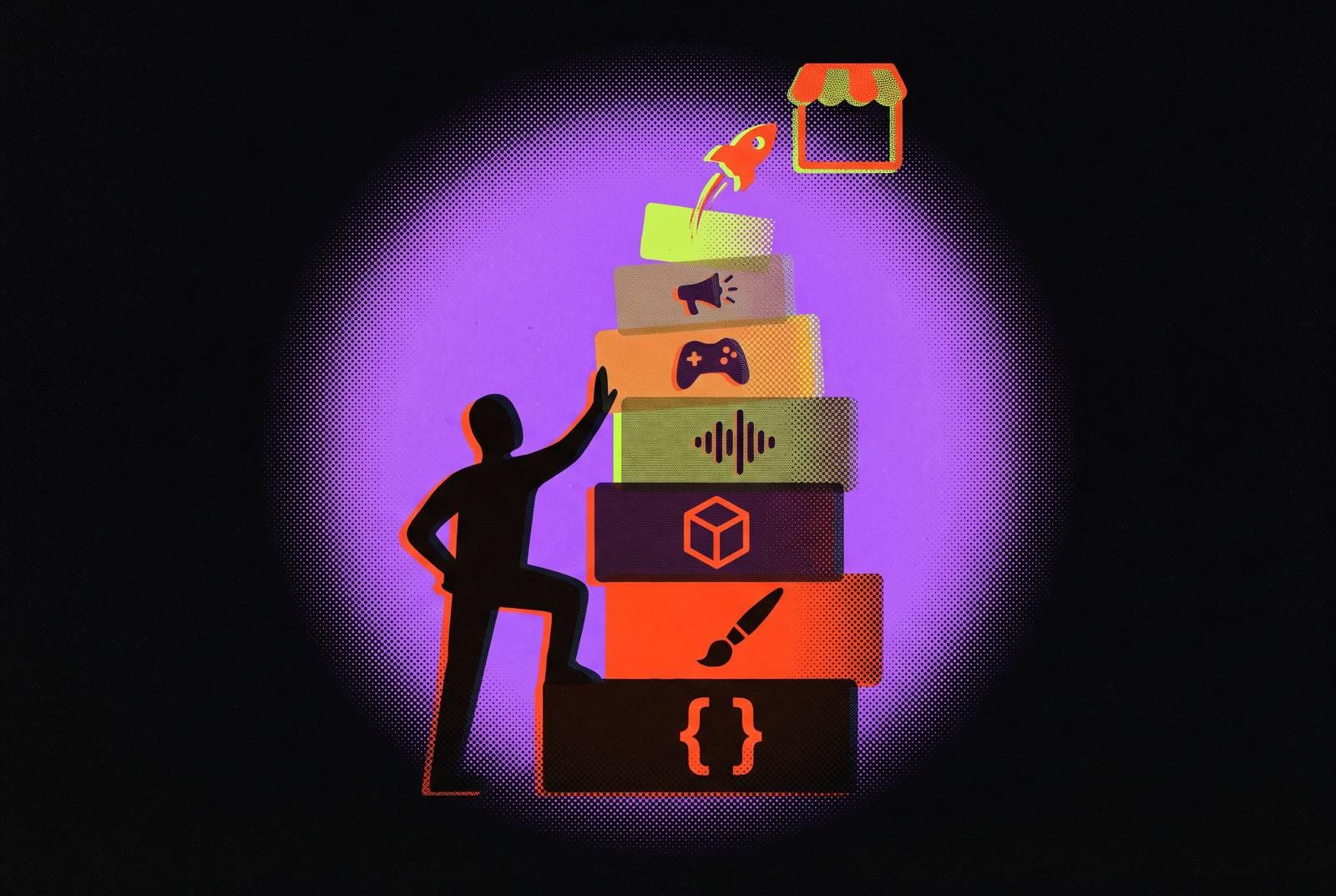
Shipping a game to Steam alone in 2026 is most achievable when AI handles repeatable production work and the creator retains control of scope, playtesting, and audience strategy. Code generation and agentic editor control help the most, but neither ensures that the game gets finished. For musicians, composers, and QA professionals without programming experience, the useful distinction is between software that generates output and a workflow that makes that output shippable.
Why shipping to Steam alone is not equally hard across every discipline
Solo development has historically demanded discipline parity, with one person expected to be a competent programmer, artist, composer, writer, and marketer. Those demands do not shrink at the same rate. AI compresses repeatable work in some disciplines while leaving the decisive judgments in others largely untouched.
The mechanism is specialization collapse, as tasks that once required separate practitioners become work a single creator can direct. The work costs less, but the creator is still responsible for it. Where AI produces usable output, the creator can move beyond a missing specialist skill. Where it cannot, that skill gap can still prevent completion.
How the ranking works and what “solo shippability” measures
Solo shippability measures how much AI can execute without deep human skill and how strongly the remaining human decisions determine release or success. A discipline ranks high when a non-expert can direct reliable production work. Clear success criteria help make that possible. So do output that needs little expert review and mistakes that are inexpensive to catch and fix.
A discipline ranks lower when quality depends on subjective feel, failures emerge late, or missing taste cannot be supplied by a prompt. Code receives the top position for its consistent, verifiable leverage, while game feel sits at the bottom because its essential evaluation remains human.
Code generation for non-coders building toward a Steam release
Code generation is the most mature layer of the solo AI stack, compressing boilerplate, refactoring, and debugging to a fraction of their former time cost. BigDevSoon demonstrated that speed by releasing a playable version of Void Balls on itch.io in just 10 days in 2026, with Steam planned for Q4 2026. A fast playable release demonstrates production leverage.
Choost Games separates planning conversations from work inside the editor, using Claude for system-design discussions and Cursor running Claude Opus for architecture, logic, and implementation. In practice, planning should come first, followed by one surgical instruction at a time and testing after each change. Failed changes should be reverted fully before proceeding. Each system needs to pass a check before work on the next one starts.
Architecture still depends on knowing the performance targets, feature scope, and platform constraints. General best practices cannot make those choices on their own. Generated code can compile yet fail when people play the game, and complex damage formulas, physics interactions, or procedural systems still cannot be relied on when success depends on how they feel.
MCP servers turn AI from a code suggester into an editor operator
Model Context Protocol, or MCP, servers extend code assistance into direct control of editors and content-creation tools. Instead of handing the creator snippets to paste and connect, an assistant can execute editor commands. The unit of delegated work becomes a project operation.
Depending on the integration, those operations include changing scenes, scripts, and resources, searching documentation, reading editor errors, and running tests. Some integrations also support turn-by-turn play with undoable actions. The operational gain is less manual wiring. For a one-person project, connecting generated pieces can otherwise consume much of the time saved by generating them.
The Blender MCP Server applies this approach to modeling, materials, UV mapping, modifiers, animation, rendering, and scene management. It brings a demanding creation tool into a workflow the developer can direct. MCP therefore ranks with code generation as a high-leverage investment, because it closes the gap between producing an answer and applying it inside the project. Human approval remains distinct from automated execution.
2D art and sprites let AI handle volume while humans set visual identity
AI-generated placeholders, sprites, tilesets, UI elements, and parallax backgrounds can reach indie-appropriate quality without a dedicated artist. This places 2D production high on the stack, below code. The strongest division of labor is AI for volume and human direction for visual identity. Item icons and background elements benefit from repeatable generation, while the defining pieces need a coherent artistic standard.
Style drift is the constraint that prevents unrestricted delegation. Individually acceptable sprites can still form an incoherent game. A locked style sheet gives selection a consistent basis through palette, camera angle, lighting, and explicit exclusions. Producing more candidates than needed allows the creator to reject images that do not fit.
ChatGPT and Grok can generate stills, OpenArt can animate selected frames, and Canva can support cleanup. Their outputs still need a shared visual brief. The retained human skill is establishing that brief and enforcing it. This makes 2D production manageable for a solo creator without making taste optional.
3D asset creation is viable for props but demanding for hero assets
AI-generated 3D meshes work well for props, hard-surface objects, and pieces of architecture in the environment. Their production path is not simply generate and ship. A usable workflow includes generating a base mesh, cleaning it in Blender, fixing texture mapping, and integrating it into the game. That cleanup burden places 3D below 2D on solo shippability.
Tripo, Meshy, and Rodin generate meshes from text or image prompts, but the remaining work depends heavily on the asset. Architectural pieces generate well, while natural formations can lack variety. Characters and organic models require more intervention. Their topology is rarely ready for animation, and UV layouts may need to be fixed by hand before the asset can be used.
The Blender integration can accelerate retopology and UV work by allowing the creator to direct those operations. It does not remove the need to judge the result. Hero assets, including the character featured on the store page or the weapon held throughout play, still demand the most human attention. They are the weakest candidates for a purely generated workflow because they define so much of the game's visible identity.
Audio, music, and voice make commercial licensing part of tool selection
Commercial licensing changes which audio tools are suitable for a Steam release, even when their output sounds ready to use. ElevenLabs Music requires a paid tier for commercial use, while its free tier is restricted to personal, non-commercial use with attribution and download constraints. Output quality is only one selection criterion. A creator shipping commercially also needs a plan whose rights cover that use.
AI can do much of the work of making voice and sound effects, including work that would otherwise need performers for many characters. ElevenLabs handles voice, while Replica Studios offers a game-focused workflow with scene-based controls, emotion controls, and SAG-AFTRA ethical licensing, from $10/month. The tools address different production needs. Their suitability depends on both the required output and the commercial terms attached to it.
Choost uses Suno for background music and ElevenLabs for sound effects, treating generated audio as production-quality for indie purposes. Music still has a creative dividing line. AI does better with ambient tracks than with the memorable melodic theme that gives a soundtrack its identity. Audio therefore ranks high for execution, while a distinctive musical identity remains a human opportunity.
Localization is a task AI can now own almost entirely
Localization sits near the top of the stack because an agent can turn a localization table or.po file into consistent, game-context-aware translations within minutes. A wide range of languages is now within a solo creator's reach. Work that once required translators for each language can consume very little production time, making localization an unusually strong candidate for delegation.
The remaining review concerns tone, game-specific jargon, and humor that does not transfer cleanly between cultures. A developer can assess tone in languages they speak. That retained judgment distinguishes rapid translation from complete cultural review. Localization deserves a place in the production plan rather than being treated as an unaffordable addition after the game is finished.
Marketing and Steam page preparation need human strategic judgment
Marketing ranks in the middle because AI can produce material quickly without deciding whether that material addresses the right audience. It can draft a Steam description before a playable build exists, generate social concept art from a design document, and outline a press kit during prototyping. Parallel production becomes practical from day one. That removes some of the pressure to treat marketing as a distraction until development ends.
Steamkit helps get a page ready with a capsule generator, page analyzer, and localization tools, and has a limited free tier and paid credits. These features address execution around the game's central discoverability asset. They do not establish market fit. The creator must still decide which audience to target, how to position the game, and how to build a community.
Stray Spark Studio distinguishes substantial savings in content creation from the strategic work of deciding what to say and to whom. That boundary is the warning within the opportunity. Generating more promotional material before validating the concept can accelerate activity without improving direction. If concept art gets no interest, that response is useful in itself, as long as the creator acts on it by changing direction.
Game feel, playtesting, and design iteration receive the least AI assistance
AI cannot judge whether a game is fun, which places game feel at the bottom of the delegation ranking. Getting controls to respond well, loops to feel satisfying, and the challenge to build at the right pace depends on real people playing under real conditions. These judgments cannot be reduced to successful compilation. A system can perform its specified function without producing an experience worth continuing.
Choost says that using AI to generate large amounts of code brings in bugs that show up only when people play the game. Failures that are hard to spot include off-by-one errors, race conditions, and collision layers that are set incorrectly. More generated code therefore increases the importance of testing.
Creative direction also needs to stay in human hands because people still have to choose systems, cut mechanics, and decide what the game is for. AI can agree that an expansive scope is achievable without supplying the judgment needed to finish it. Scope control is therefore a central solo skill. This is not work left over after automation fails, but the creative core that automation can make time for.
The Steam publishing process is procedural, learnable, and largely AI-assistable
Steam Direct charges $100 per game, recoupable after a threshold in adjusted gross revenue, and requires a wait after payment. A Coming Soon page must also be public for a minimum period before release. Tax and bank verification add calendar time. A company is not required, since an individual or sole proprietor can publish under their own name.
Valve takes a share of base sales, with the percentage dropping at higher revenue thresholds. These commercial and procedural requirements need planning, but they are not the main creative risk. AI can help with copy, tags, press materials, and localization while the developer handles the timing and what is needed for review. An earlier prototype on itch.io, which is free to publish on, can generate player feedback and a community before the commercial release.
What the stack ranking tells a solo creator about where to invest in 2026
The practical response to this ranking is to shift time from repeatable execution toward playtesting, creative direction, and audience development. Code generation and editor control offer the strongest starting investments, followed by high-delegation work in 2D assets, localization, and audio. 3D needs a larger cleanup allowance. The creator still needs to steer the marketing even when the work of making the material costs little.
Tool selection should also account for coordination overhead and the quality of individual outputs. An environment that combines code generation, asset creation, and publishing support reduces the work of managing separate production steps. Integration is part of solo capacity. For a non-coder, the relevant comparison is therefore how much of the working pipeline can be directed, rather than how impressive one generated result looks.
Before starting, the creator should identify which disciplines they can judge personally and which they intend to delegate. A musician, composer, or QA professional brings a different starting position to that decision. None needs to become an equal specialist in every field. The solo creator who ships acts as a creative director, delegating execution while retaining responsibility for what the game becomes.