Audiocraft vs Stable Audio for AI Sound Effect Generation
AudioCraft's non-commercial license makes Stable Audio the safer choice for shipping games.
AudioCraft and Stable Audio offer different paths to AI sound effect generation. Their architectures shape the sounds they make, and their licenses set the rules for commercial use. For game developers, the right choice follows from the audio task, the production workflow, and whether the resulting assets can ship.
Why the AudioCraft vs. Stable Audio choice is not just a quality question
A convincing preview is only the first test. A generated sound must also fit an event, hold up after editing, and be legal to use where it will ship. Meta’s AudioCraft is an open-source framework built around discrete audio tokens produced by a neural codec. Stable Audio instead uses latent diffusion, taking the same class of architecture used in image generation and applying it to audio synthesis.
Those choices affect duration, resolution, and the balance between how well the sound preserves transient definition and sustained texture. They also sit under different licensing arrangements. AudioCraft’s permissive code license does not extend to unrestricted commercial use of its pretrained weights, while Stable Audio provides a commercial licensing path. Choosing between them therefore requires understanding both the generation architecture and the rights attached to its use.
How AudioCraft's token-based architecture shapes what it produces
AudioCraft combines three models with distinct roles. AudioGen makes environmental sounds and effects from text and was trained on public and licensed sound effects data. MusicGen makes music from text and was trained on Meta-owned and licensed music. EnCodec supplies the shared tokenizer, compressing waveforms into discrete tokens for both generation models. The codec-and-token pipeline defines the framework’s approach to sound generation.
For game audio, this approach suits ambient textures and experimental sounds where an exact opening attack is not the central requirement. Local batch generation is another useful fit. Teams with GPU resources can make many sounds without paying for each one, which helps them try out variations during non-commercial pre-production. Its practical generation limit is roughly 30 seconds, with output at 32kHz/16-bit.
That same pipeline is less accommodating when a sound depends on its opening milliseconds. Weapon hits, UI clicks, and footsteps need a well-defined transient to register as a physical or immediate event. That definition is harder to coax from AudioCraft than from diffusion-based alternatives.
Meta also provides training recipes for adapting the models to custom audio corpora. Fine-tuning therefore gives technically equipped teams a route toward a more specific sound palette. It does not, however, remove the pretrained weights’ licensing restrictions.
How Stable Audio's diffusion architecture produces different trade-offs
Stable Audio generates through latent diffusion. Its strengths are most useful in layered textures, ambient beds, and evolving soundscapes, where coherence across time is part of the asset. Longer output gives those sounds more time to develop. However, diffusion alone does not make it the strongest choice for sharp impacts, where purpose-built one-shot generators tend to offer better transient precision.
Stable Audio 3.0 came with three open-weight variants on Hugging Face. Small SFX is a dedicated sound-effects model, separate from the music models. Small can generate full music on consumer hardware, while Medium can make tracks up to around six minutes and twenty seconds. These are distinct deployment choices rather than interchangeable specifications for a single service.
Generation speed also affects how readily a creator can iterate. Reported generation takes under two seconds on an H200 GPU and a few seconds on a MacBook Pro M4 with the small model. Medium performance on the M4 is not officially benchmarked.
For studios with an established audio identity, the release also introduced LoRA fine-tuning. A studio can adapt the base model using an existing soundtrack, a genre library, or a brand audio corpus. The resulting adapters stack and blend at runtime. Separate adapters for dungeon ambience, overworld themes, and boss encounters can therefore be combined without retraining, although this workflow requires ML expertise and appropriate hardware.
The duration and resolution gap between the two tools in practice
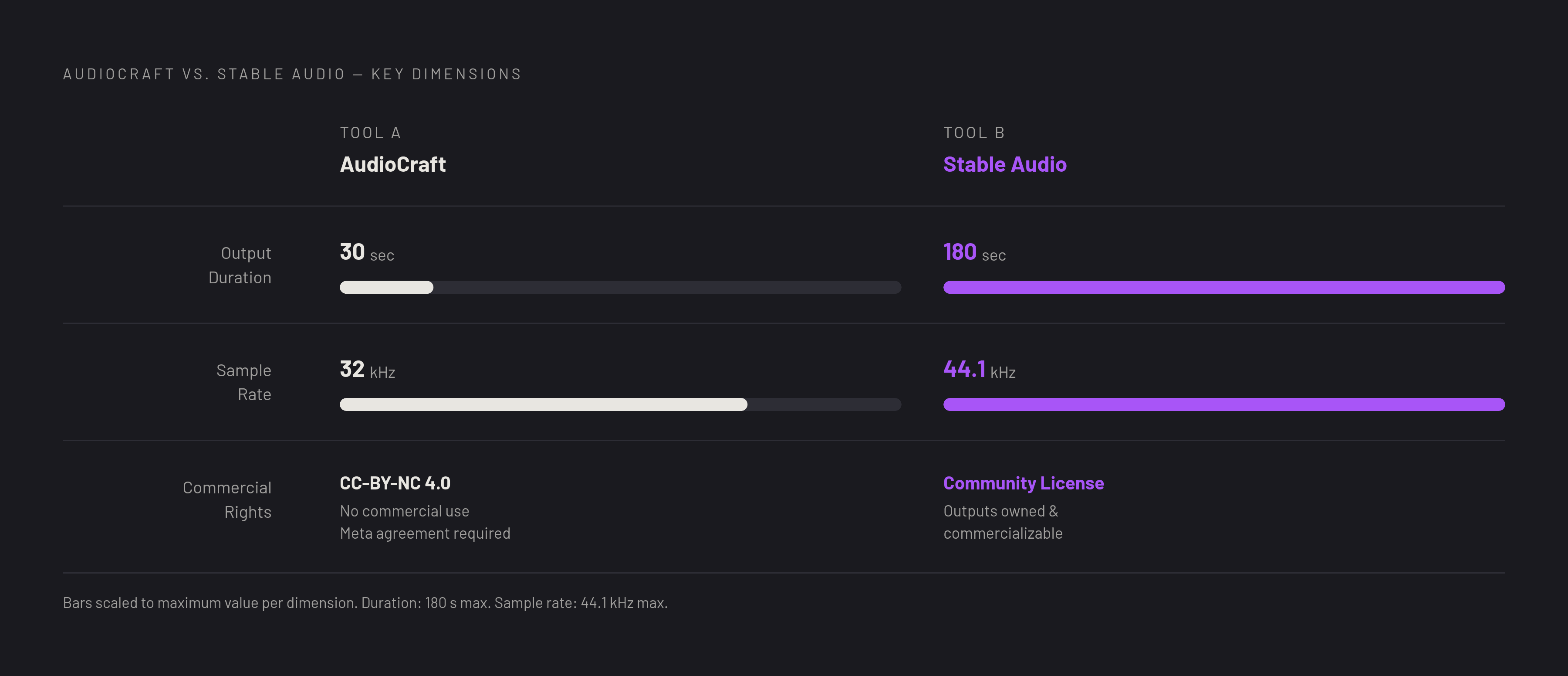
Stable Audio 3.0’s hosted service produces up to 180 seconds at 44.1kHz/16-bit, whereas AudioCraft AudioGen offers much shorter output at 32kHz/16-bit.
A longer generated clip offers more space in which to find a clean loop region, making Stable Audio the more practical option for evolving beds. AudioCraft’s roughly 30-second limit makes shorter ambient loops harder to construct.
Resolution has a different effect on finished audio. The gap between 44.1kHz stereo and 32kHz is audible, particularly in designs with high-frequency content such as metallic impacts, UI tones, and weapon sounds. Yet neither duration nor resolution guarantees a usable loop. Prompts such as “seamless loop” and “loop-ready” rarely eliminate audible loop artifacts in either tool, so loop construction remains a post-production task.
Spatial processing presents another shared constraint. The recommended approach is to prompt for “dry, no reverb” and add spatial processing in the game engine. This preserves flexibility for positional audio. It also avoids embedding a room tone that conflicts with the acoustic environment in which the sound will play.
Why licensing is the most consequential difference for shipped games
AudioCraft’s license separates the software from the pretrained models. The code uses the permissive MIT license, while the weights use CC-BY-NC 4.0, which prohibits commercial use without a separate agreement from Meta. Code access is not commercial audio clearance. Fine-tuning does not change the weight license, so a customized model retains the same restriction.
For a game that will have a commercial release, AudioGen output must therefore stay in the prototype unless a separate legal agreement allows commercial use. Non-commercial prototyping is still allowed. In that setting, teams can generate as many sounds locally as they need, which can help during pre-production when they want to try many sounds. However, the non-commercial restriction should not be treated as a rule that becomes relevant only on release day.
Stable Audio provides a different commercial path. The Stability AI Community License allows users to own and commercialize outputs, subject to registration and attribution requirements. Organizations above its annual revenue threshold need an Enterprise license. The earlier Stable Audio Open 1.0 weights used recordings from Freesound and the Free Music Archive licensed under CC-0, CC-BY, or CC-Sampling+, which is a separate training-data detail rather than a substitute for the applicable model license.
Other AI audio services face major-label copyright infringement suits in 2025–2026, increasing caution among enterprise legal teams. AudioCraft’s barrier comes from its explicit non-commercial weight license.
The planning consequence is straightforward. A team relying on AudioCraft for eventual shipped audio needs a licensing resolution before release, and there is no established pathway for Meta to grant commercial rights to AudioGen outputs at scale. Prototype access does not establish that such an agreement will be available. Leaving that question unresolved creates a project risk regardless of how well the generated sounds perform.
Which tool fits which game audio task
For one-shot effects, including weapon impacts, UI clicks, footsteps, and spell casts, neither framework leads dedicated generators on raw transient precision. Of these two options, Stable Audio Small SFX can be used in games that ship commercially under the applicable license. AudioGen fits non-commercial prototyping and high-volume local exploration. The recommended listening test is to inspect the attack at half speed first, because a smeared transient can make a sound feel late regardless of its timing.
For ambient beds and evolving textures, Stable Audio is the stronger fit when a longer coherent clip is needed for loop construction. Its hosted duration gives the editor more material to work with. AudioCraft remains useful for shorter textures and experimental ambience. Its tighter duration limit makes editing more restrictive.
For batch variation, AudioCraft’s local generation economics are a practical advantage during non-commercial pre-production. Teams with GPU resources can explore many versions without a marginal generation charge. Stable Audio is the production-ready option when teams need rights to ship the sounds commercially.
For a studio-specific aesthetic, Stable Audio’s commercially viable LoRA workflow offers runtime adapter stacking and blending. That fits studios with an existing audio corpus and the technical resources to adapt a model. AudioCraft also supports fine-tuning, but its weight license limits commercial use of the result.
How the AI agent layer is changing which tool matters most
For indie developers and game-jam participants in 2026, direct model selection is increasingly being mediated by an agent layer. Instead of asking a creator to choose every generator, an agent can coordinate the components of an audio scene. Model selection then depends in part on how cleanly a model fits the larger process.
Audio-Oscar coordinates specialist agents for character modeling, voice design, speech generation, timeline planning, model selection, non-speech generation, and post-production. Its scope extends beyond producing an isolated clip. It addresses scenes containing dialogue, ambience, event effects, and background music, where generation and editing otherwise require separate tools. That orchestration makes access and integration part of the model’s practical value.
Alibaba Token Foundry’s July 2026 Qwen-Audio-3.0-Gen-Preview research demonstrates a related approach to complete scene generation. Its unified non-autoregressive framework uses a Diffusion Transformer in a shared VAE latent space to generate mixed waveforms at 48kHz stereo. These can include heterogeneous audio components, ambience, and multi-character dialogue. Its reported strengths include cross-turn speaker consistency and temporal localization, so the comparison also covers how sounds work together across a scene.
Stable APIs and clear commercial terms favor Stable Audio’s commercially licensed, API-accessible family over AudioCraft’s locally hosted, non-commercially restricted models. For time-constrained creators, the choice may depend on which tool the agent handles cleanly. Architecture still shapes the output, but the creator may interact mainly with the system that coordinates it.
How Summer Engine fits this audio workflow and what to consider when choosing a path
Summer AI, its in-engine agent, can generate sound effects, background music, spoken lines, and multi-character dialogue, then wire them to game events. The creator does not have to manage a separate generator, export WAV files, and import them manually.
Summer Studio provides the generative asset workspace inside the engine. It handles audio together with 2D, 3D, and other asset types under a single subscription, giving access to models for code, art, audio, and music without separate provider accounts. Assets generated inside the engine belong to the creator and can export to Steam, itch.io, and mobile. That supplies a commercial shipping path that AudioCraft’s non-commercial weight license does not provide on its own.
The integrated route also retains implementation control. For game-jam workflows, the benefit is a shorter path from describing a game to having working audio attached to its events. Its place in this comparison is therefore not as another standalone sound model, but as an option for creators who want generation and implementation handled together.
For creators who choose a standalone tool, Stable Audio 3.0 Small SFX is the open-weight option they can use commercially, with LoRA fine-tuning to give a studio a consistent sound. AudioCraft AudioGen remains a strong fit for high-volume local generation under a non-commercial constraint, provided any intended commercial use has a legal resolution before shipping. Neither path removes the finishing work. The recommended manual discipline is to normalize to -3 dB, trim silence, and construct loops with a 50–100ms crossfade, while keeping spatial processing in-engine.