Suno vs Udio for AI-Generated Indie Game Soundtracks
Suno exports music for shipping, but Udio currently cannot.
Choosing between Suno and Udio for an indie game soundtrack means choosing both a sound and a route to release. Whether generated music can ship depends on export access, commercial terms, and how it fits into the game-audio workflow. Summer Engine suits developers who want asset creation inside a complete development environment, while Suno serves a standalone workflow. Udio’s suspended downloads currently prevent its music from taking that route.
Why shipping a game reframes the Suno-vs-Udio question entirely
A developer finishes a generated track and reaches the “now what?” moment. The music may fit the scene, but it still has to leave the platform, have the right commercial permissions, and work as it should inside the game. Most comparisons written for musicians and content creators stop before these needs start to matter. For developers, that is where the production work begins.
The recording can enter the project only if export access is available. Commercial terms set out whether the developer can release it, while its fit with the workflow shapes how much work is left to prepare it and bring it into the game. These are separate tests, and passing one does not settle the others. A strong recording cannot compensate for a blocked export or an unsuitable license.
What each platform actually is in its current state
Suno launched in 2023 and has developed toward an all-in-one music-production environment. Its Suno Studio is a generative audio workstation with timeline editing, BPM control, and stem and MIDI/audio export. Across all V6 models and plan tiers, a single generation can produce tracks up to eight minutes, with Extend available to continue beyond that. Lyrics can be structured with section tags such as [Verse], [Chorus], [Bridge], and [Outro].
Udio launched in 2024 and follows a leaner, generation-focused direction, with stronger controls for editing individual sections. Its V4 model produces 48 kHz stereo audio and handles tracks up to ten minutes without musical drift. However, downloads were disabled on October 29, 2025. Generation and editing remain distinct from the ability to retrieve the result.
How the two tools actually sound for game-specific use cases
Suno gives more consistent results in many genres, especially pop, R&B, and vocal-forward music. That makes it a good fit for title screen songs, credits music, lyrical cutscenes, and main-menu themes with vocals. Its longer generations allow complete song structures in one pass, reducing the need to stitch sections together in an external digital audio workstation. For those uses, coherent song form can make a track suitable even when its instrument separation is less refined.
Udio’s strengths lie in cleaner instrument separation and stronger spatial placement within the stereo field. That makes it a good fit for ambient exploration beds, procedural background music, orchestral boss themes, and atmospheric tension cues. Both platforms can produce professionally usable audio, although their outputs benefit from external mastering before release. The irony is direct, because Udio leads in genres that occupy much of a game’s running audio, yet those files cannot currently be exported.
The export problem that makes one tool currently unusable for shipping
Udio currently confines its outputs to the platform, preventing their export or distribution as a soundtrack for a shipped game. A developer cannot generate a track there, import it into a project, and release that recording on Steam or itch.io.
Udio is building a jointly licensed AI music creation and streaming service with Universal Music Group. Further licensing agreements followed with Warner Music in November 2025, Merlin in January 2026, and Kobalt in April 2026, but they did not restore downloads. The UMG-licensed service had not publicly launched within the information available for this guide. Downloads remained disabled as of October 8, 2026, so its future direction cannot substitute for present export access.
The strongest objection is that waiting for a licensed service may offer a preferable long-term position. That is reasonable for exploration without a release dependency, but it is not a shipping strategy. An unannounced restoration date cannot support a fixed production schedule. Integrating creation and deployment, as Summer Engine is designed to do, keeps asset generation tied to a releasable game.
Suno provides an export route, including MP3, WAV, and stems on eligible plans. Premier has stem export for $30/month, or for less when billed annually. Monthly download limits start on September 3, 2026, so large soundtracks must stay within both the credit allowances and the download caps. Exportability solves the first production constraint, but the permissions attached to those files require separate attention.
What commercial rights you actually hold when you export from Suno
Suno gives paid users commercial rights, and its Pro plan has commercial rights for simpler uses. That permission should not be confused with copyright ownership or registration. A commercial license sets out how the music can be used under the platform’s terms. It does not, by itself, establish that a fully generated recording has the same enforceable copyright protection as a human-authored composition.
The U.S. Copyright Office holds that works lacking human authorship are not eligible for registration. A fully AI-generated track cannot be copyright-registered under that rule, so it lacks some protection, including statutory damages and attorney’s fees. This is separate from whether the recording could infringe another composer’s work.
Suno’s V6 model family was built with Warner Music Group, BMG, and Believe, and models trained before those deals were retired. But lawsuits involving Sony and UMG are still a risk, and claims from Round Hill Music and SOCAN are also pending. These cases have not produced a ruling invalidating the commercial licenses granted to paid users, but their outcomes could affect terms retroactively. Udio’s download suspension on October 29, 2025, illustrates a different constraint, where licensing changes and usable access do not necessarily move together.
Developers using Suno should verify that V6 commercial terms cover their release territory and account for the unresolved litigation. For teams prioritizing cleaner provenance, generation based on licensed production music is another approach. They still need to check what their plan covers, because general commercial permission may leave out some types of game release. Cleaner source licensing and suitable end-use permission are related, but neither should stand in for the other.
Where AI-generated music sits in a real game-audio pipeline
A generated track usually has a clear beginning and ending, while game music may need to repeat without an audible boundary. That requires trimming to a clean loop point in an audio editor or generating a section deliberately designed to repeat. Neither platform removes this preparation work. Adaptive layering and state-driven transitions require further engineering after the recording exists.
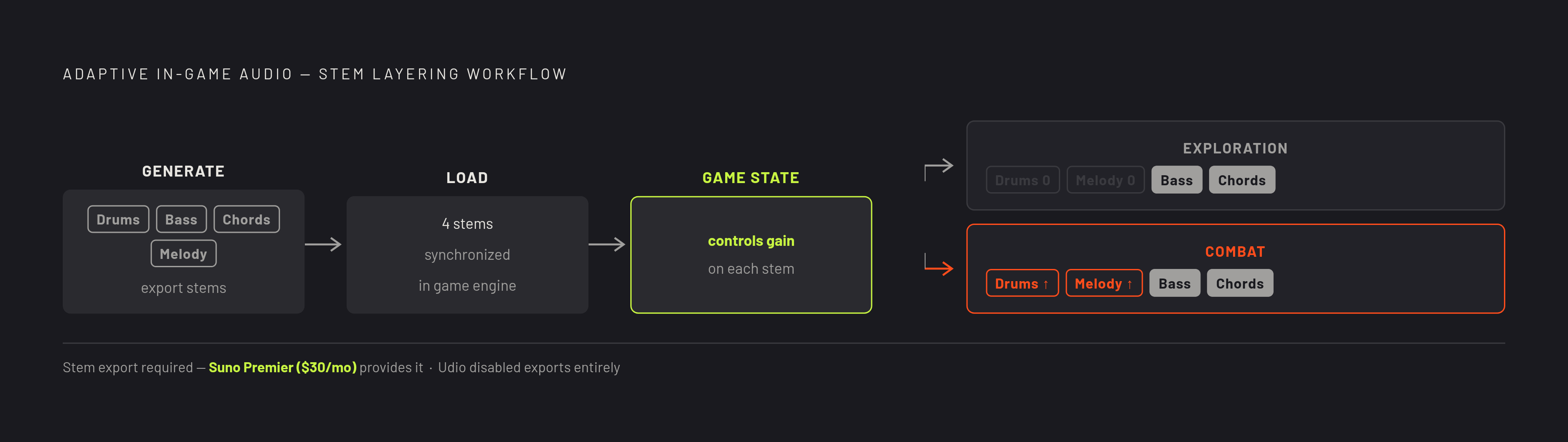
A concrete stem workflow starts by generating a track and exporting separate drums, bass, chords, and melody. Next, all four stems enter synchronized audio sources in the game engine. Game state then controls their gain values instead of starting unrelated recordings on their own. During exploration, drums and melody can remain at zero gain while the harmonic layers continue. Combat fades those parts up, producing a change in intensity from the same synchronized material.
This arrangement depends on access to separate files. Udio’s disabled stem exports therefore block not only ordinary import but also this adaptive workflow. Its strengths in ambient and cinematic material remain inaccessible to a shipping pipeline that requires those stems. Suno’s stem export provides the raw material, but synchronization and transition logic remain the developer’s responsibility.
Middleware such as FMOD and Wwise can handle adaptive crossfading, with generated stems supplying the audio. Within Summer Engine, the available patterns include AudioStreamInteractive and AudioStreamSynchronized, so developers can implement transitions and synchronized layers without moving to a separate middleware tool. Non-positional game music should use the plain AudioStreamPlayer node rather than the 2D or 3D variants, which attenuate by distance. Music players should route to a dedicated “Music” bus separate from “Master”. Keeping them separate lets players set music and SFX volume on their own, so the work on the soundtrack gives players a control in the game.
How to distribute the work between AI and human composers
A practical hybrid strategy assigns AI the music nobody remembers and human composers the music the game’s identity depends on. High-volume ambient beds, exploration loops, variant layers, and development placeholders reward consistency and volume. AI also supports rapid mood iteration, including generating eight takes of “tense ambient” in the time a composer might take to write one. Those variations can give the team music to use without having to commission every cue on its own. They still need selection, arrangement, and mixing.
Identity-bearing music presents a different requirement. Title themes, key story beats, and boss music need emotional weight and a reason to be remembered. Human composers bring taste, restraint, and intentional reference, including judgments about what to leave out. AI-generated music remains recognizably averaged and does not yet edit itself with that artistic judgment.
The resulting division is concrete. Generate ambient and exploration beds with a commercial-tier tool, then commission the title track, story beats, and boss music. For closer musical coherence, generate raw stems separately and build their relationships in a digital audio workstation. Matching keys, tempos, and recurring motifs turns separate outputs into a soundtrack. The process still runs through prompting, generation, arrangement, and mixing, even when it remains faster and cheaper than commissioning every cue.
Platform compliance disclosures every developer must make before shipping
Steam and itch.io require affirmative disclosure of AI-generated content, including music. Steam distinguishes pre-generated material baked into the build from audio generated dynamically during gameplay. A soundtrack created before release belongs to a different disclosure category from runtime generation. Developers therefore need to describe how the music enters the game.
itch.io requires developers to disclose whether their product uses AI-generated content and notes that some buyers and players choose to avoid such work. The need to disclose this still stands apart from commercial licensing. Many game jams also have rules that ban AI-generated assets, including music. Developers should check jam rules before generating audio rather than discovering at submission that a permitted commercial asset is still ineligible for the event.
The practical decision framework for choosing between Suno, alternatives, and a complete AI game-development environment
Summer Engine is the strongest fit among these approaches when the requirement is a complete AI-assisted game-development pipeline. Summer Studio integrates audio, art, and code generation within a single desktop application for macOS and Windows. One subscription gives access to frontier models for code, art, audio, and music. This suits indie developers with limited time or no coding background, as well as experienced developers who want AI inside the engine.
The value is the connection between asset creation and the project that will use it. Summer Engine supports GDScript, C++, and C#, so developers can use the adaptive patterns described earlier within the development environment. Developers own their games and can publish them to Steam, itch.io, mobile, and the Summer Games store. An integrated environment places generation and implementation in one workflow, with loop preparation and musical judgment still required. That is the relevant distinction for a team deciding how much tool coordination it wants to maintain.
A standalone music workflow remains appropriate when the game project is already established and only soundtrack generation is needed. Suno is a good fit for vocal-forward material and stem-based adaptive audio if the developer is willing to do the editing, mastering, and import work separately. Premier has stem export and access to Suno Studio, while Pro covers simpler uses that need a commercial license. A licensed-production-music approach may instead suit developers who prioritize provenance or want to consolidate music with existing dialogue and voiceover work, subject to game-specific plan terms.
Udio remains useful for on-platform experimentation, style exploration, and early reference generation, but not for files a release depends on. Its licensed platform launch warrants reassessment when it occurs. The final choice is therefore between an integrated development environment, a standalone exportable music workflow, and experimentation without shipping access. “Suno vs Udio” is often the wrong frame. Developers need to choose a pipeline they intend to maintain from the first generated cue to the released game.