AI Coding Agents for Game Logic vs Boilerplate Code Generation
AI excels at boilerplate but needs runtime feedback loops to handle game logic reliably.
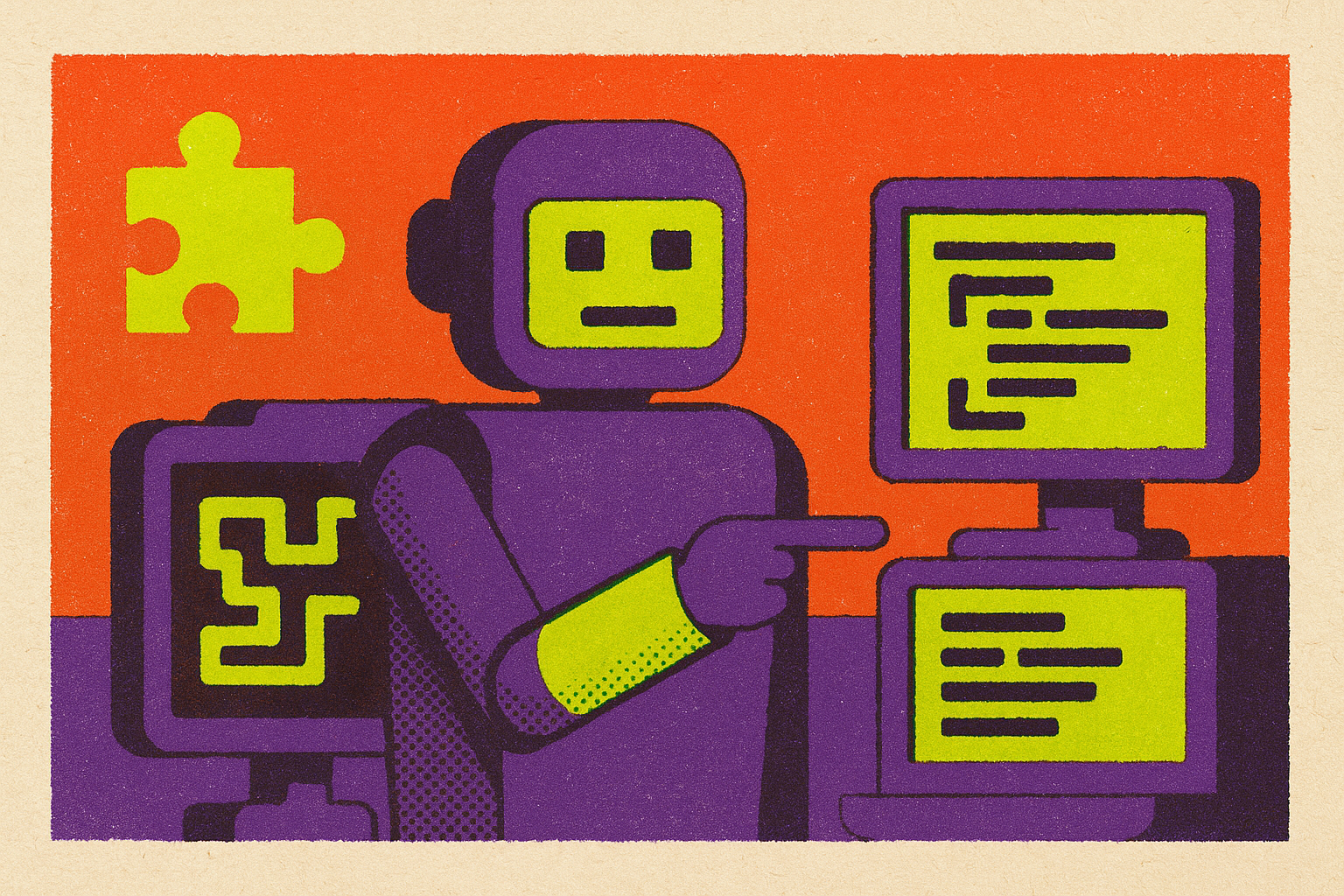
Most developers approaching AI coding agents in 2026 ask the same question: can it write an enemy state machine, can it wire up an inventory system, can it generate a dialogue tree. That's a capability question, and capability isn't the practical limit anymore. The limit is validation. Code that a tool can check syntactically, confirming it parses, that types match, that a function signature is well-formed, belongs to a fundamentally different category than code whose correctness only becomes apparent once a scene is running, a player is pressing buttons, and systems are interacting in ways no static check can predict. A syntax error appears in the code the moment the agent writes the line, while a runtime error, a null reference, a signal that fires in the wrong order, a state machine that locks up under a specific input sequence, becomes visible only once the game actually runs. This distinction, not raw capability, is what should shape every decision a developer makes about where to delegate to AI and where to keep the keyboard.
Boilerplate in a Game Project
Boilerplate, defined precisely, is any code whose correctness can be confirmed without running the game. That category is larger than it sounds, and more valuable than developers tend to credit. For prototypes and smaller projects, a codebase running a few thousand lines, building a full framework or scaffold around that size is well within what current agents handle in a straightforward way. The speed gain is substantial: AI generates this class of code quickly, with high accuracy, and with little correction overhead required afterward.
What makes this reliability possible has less to do with the sophistication of any given model and more to do with the format the project lives in. Agents help most on engines whose project state is stored as plain text, because text is something a language model can read, reason over, and rewrite with confidence that it has seen the whole picture. Engines that serialize state into binary formats or visual graph representations resist this kind of AI assistance because the agent has no text to read. The text-readability of a project's file format is the foundation the boilerplate/logic distinction is built on, and it's why Godot compatibility matters for a tool like Summer Engine, which supports GDScript in a backward-compatible way: developers can move between hand-written code and AI-assisted code while keeping the verifiability that makes the boilerplate layer work.
Game logic as a validation problem
Game logic is harder to confirm as correct than boilerplate, and that gap in verifiability is where AI assistance starts to degrade. Game feel, balance tuning, and the final stretch of integrating multiple systems together are where current tools weaken, because judging whether code for a jump arc or a damage formula feels right requires actually playing the game and watching how systems behave against each other. None of these show up when the code is generated. They show up when the scene runs.
Version drift is the most common failure mode across every model tested on this kind of work. AI assistance tends to hold up for the earlier parts of a project: movement systems, basic state machines, UI wiring, placeholder content. It weakens as the codebase tightens, as systems start depending on each other's runtime state, and as the cost of a wrong inference compounds across files.
This is the evidence base for a specific kind of discipline, described later in this piece, about when to hand a task fully to an agent and when to treat its output as a draft. A randomized controlled trial run by METR researchers found that experienced developers were measurably slower when using AI tools on complex tasks, even while believing themselves to be faster. The implication is direct: developers' sense of where AI is saving them time cannot be trusted on complex, mature codebases, and needs to be checked against an actual test, not a feeling. Architecture and business logic, the decisions that require domain knowledge about what the game is actually trying to do, are where professional developers consistently report agents as unsuitable. In a game, a bloated state machine or an over-engineered physics helper is genuinely hard to debug once it's being exercised under live play conditions.
Agentic feedback loops and game logic
The development that actually changes the picture for game logic is a tighter feedback loop: an agent that can press play, read the resulting runtime error or look at a screenshot, and correct its own mistake closes the exact verification gap described above. Agentic tools outperform simple autocomplete for game development specifically when they have this runtime loop attached, not merely a loop that generates text into a file. The real test of any tool in this category is whether it can press play, observe what happens, and fix the problem itself, without a developer manually copying an error message back into a chat window. Without that loop, generated game logic is a draft, something that still needs a human to test and correct by hand. With it, the agent becomes part of the validation step, which is what makes its output for logic trustworthy rather than merely plausible.
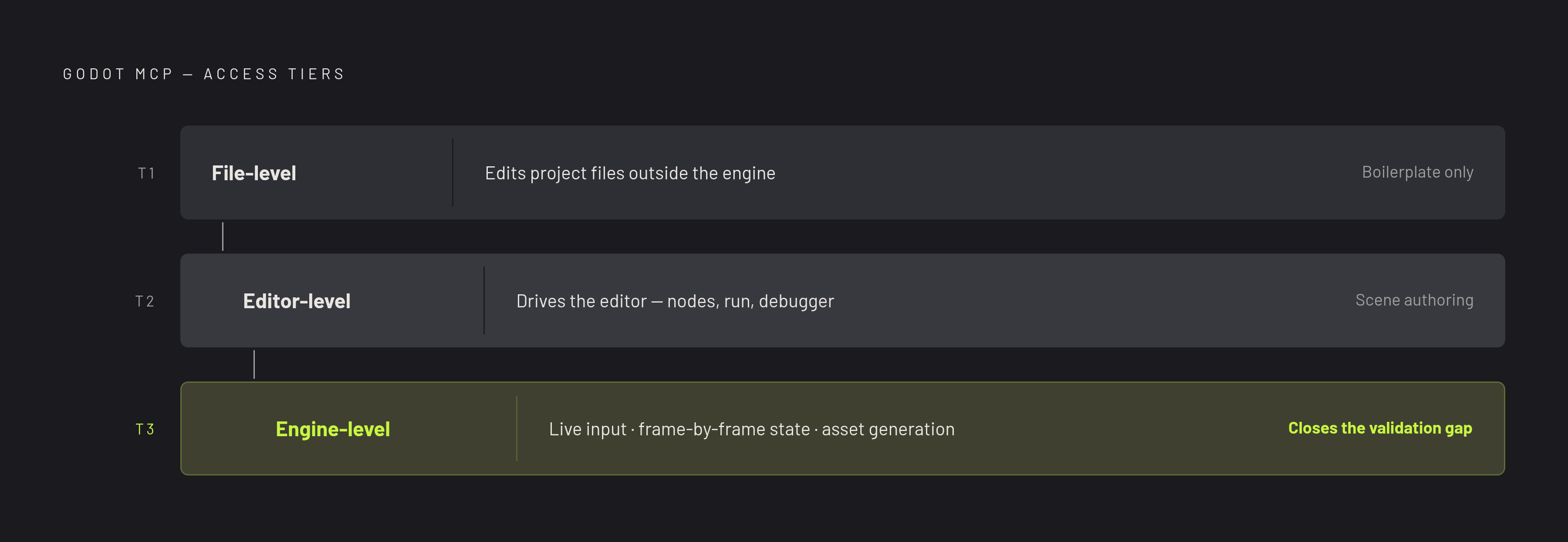
The structural mechanism that made this possible is the Model Context Protocol, open-sourced by Anthropic on November 25, 2024, which lets an agent reach into a running engine rather than being limited to editing project files from outside. MCP has since grown into something close to an industry standard, with adoption from Anthropic, Cursor, Windsurf, and OpenAI among others. For Godot specifically, three tiers of MCP server exist, and the tier maps directly onto the boilerplate/logic distinction described earlier in this piece. Editor-level servers go further, driving the Godot editor itself to create nodes, run the project, and read debugger output. Engine-level servers add full runtime control: sending input to the running game, probing its state frame by frame, and generating assets on demand. File-level access is enough for the boilerplate layer. Engine-level access is what unlocks reliable assistance on game logic, because it's the only tier that gives the agent something to validate against.
One compound workflow this tier makes possible: pairing Godot MCP with a Blender MCP server in the same agent session lets the agent model a prop in Blender, export it to glTF, drop the file into the Godot project's assets folder, configure its import settings, and add the resulting scene to the level, all without a developer shuffling files by hand between applications. This is the structural reason an engine-native approach changes what's possible. When AI is built into the engine rather than bolted on as a separate tool reaching in from outside, the feedback loop between describing a change and seeing its result stops depending on a developer relaying errors manually. Summer Engine's architecture reflects this directly: AI lives inside the engine itself rather than operating as a separate chain of tools, so its conversation-driven interface works against a live runtime by design, and a description of a change can be followed by Summer AI pressing play, watching what happens, and iterating, without a human in the loop copying error text from one window to another.
The GDScript-specific AI landscape
Godot's own language choices make this kind of assistance more reliable than it would otherwise be. The most common failure across every model tested on this language is drift toward Godot 3 syntax, a calibration problem rather than a fundamental barrier, and one that tools capable of reading the live project are able to correct for.
Summer Engine sits at the front of this landscape as an engine-native option built around that calibration advantage. Summer Engine is backward compatible with Godot and supports both GDScript and C#, with C# available in the desktop editor. Professional developers and people without a coding background can work inside the same project without one group needing a different tool than the other. Its publishing pipeline reaches Steam and itch.io directly, while mobile builds still require each platform's own toolchain and signing process, so for desktop and web targets the loop from writing code to shipping a build stays inside a single tool.
Developers who prefer to work with external tools rather than an integrated engine have three established approaches available for GDScript as of mid-2026, each with its own trade-off. Agentic terminal tools, with Claude Code as the strongest option in this category, handle long multi-step chains, creating a node, writing its script, wiring its signal, without losing track of the sequence, though Claude Code has no free tier and requires a paid plan; it also shows the least version drift of any external tool tested against Godot 4. Open-source community plugins round out the field, with the Godot AI Assistant Hub, built by FlamxGames, as a free, open-source Godot 4 plugin that embeds a chat panel directly into the editor, reads highlighted code, writes GDScript back into the project, and routes requests through a developer's own choice of LLM provider, including Ollama, Gemini, xAI, and OpenRouter. Its trade-off is setup overhead, because it operates at the file level and has no runtime feedback loop connecting it to the engine. On raw model quality for GDScript specifically, Claude Opus produces the cleanest Godot 4 code and drifts into Godot 3 syntax the least often, GPT runs close behind it, and DeepSeek stands out as the strongest budget pick. Model choice matters most precisely when the agent in question has no way to read the live scene tree and has to rely on its training alone.
How to structure your workflow around the boilerplate/logic boundary
The productive rule is to use AI iteratively for both boilerplate and logic, while keeping the test cycle short enough that any given error has exactly one suspect. The working discipline is simple to state: prompt one change, press play, observe the result, then prompt the next change. Resist the urge to batch several changes together and run them all at once, because when something breaks after a single isolated change, that change is the only thing it could be. This is the same principle that makes test-driven development effective in traditional software: the feedback loop itself is the quality mechanism, and AI doesn't replace that loop, it just makes each pass through it faster.
Scope discipline matters at the project level in the same way. Cutting the core gameplay loop down to one sentence before generating anything keeps a prototype honest: it's a hypothesis about what might be fun, not a running feature list waiting to be filled in.
The practical split follows from everything above. Architectural decisions, how systems communicate, what data the game actually owns versus what it merely derives, belong with the developer. Professional developers consistently report that agents are unsuitable for exactly these judgment calls, because they require domain knowledge about the specific game being built, not pattern-matching against games in general.
Research on human-agent collaboration gives developers a sturdier way to evaluate any given tool against this split: task alignment, whether the agent understands what's actually being asked for; verifiability, whether the output can be confirmed correct; steerability, whether the agent can be redirected mid-task rather than restarted; and adaptability, whether it improves as the project itself matures. Verifiability is the dimension most often ignored in game development workflows specifically, and it's also the dimension most directly addressed by engine-level agentic tools, as opposed to tools that only generate text into a window. A developer who adopts tomorrow morning: batch the boilerplate, test after every single logic change, and keep architectural calls in human hands.
Where the 70/30 split leaves non-technical creators
Whether a game actually ships is determined not by the part of development AI handles well, scaffolding, boilerplate, common engine-idiomatic patterns, but by the parts that come after it. The last stretch, integrating systems against each other, polishing how the game feels, and getting a build through a platform's delivery pipeline, is where AI assistance thins out most severely, and non-technical creators feel that thinning most acutely. AI gets a developer without a coding background to a working prototype quickly, often faster than traditional tooling ever allowed. A prototype is not a product, and the gap between the two is exactly the gap this piece has been describing: the part of the work that requires validating against a running game, not generating more code for one.
For a developer without prior coding experience, that validation loop is harder to execute well, because recognizing that a bug is version drift, or that a state machine bug is a null reference rather than a logic error, depends on background knowledge the generation step doesn't supply on its own. The tools and tiers described throughout this piece, file-level MCP servers for boilerplate, engine-level servers and integrated engines for logic that needs runtime confirmation, external IDEs, terminal agents, and community plugins for developers who want to assemble their own stack, all exist to narrow that gap, not eliminate it. Shipping a game still depends on someone, technical or not, closing the loop between what was generated and what actually happens when a player presses play.